
Chapter 11 – Contour Maps and Landforms
Maharashtra Board Textbook Solutions for Standard Seven
Q.1. Answer the Following Questions
1) How can the distribution of height and landforms in a region be shown?
Ans: The distribution of height and landforms in a region can be shown with the help of contour maps.
2) To whom are contour maps useful?
Ans: Contour maps are extremely useful to mountaineers, trekkers, soldiers, defence officers, planners, and engineers, as they help in understanding the height and slope of the land.
3) What do you understand by observing contour lines?
Ans: Contour lines are drawn at equal intervals and join places of the same altitude above sea level. By observing contour lines, we can understand:
- The height of a peak above sea level.
- The slope of the land (steep or gentle).
- The shape and extent of landforms such as mountains, valleys, and plateaus.
Thus, contour lines help us study landforms and draw conclusions about the region.
4) How will a contour map be useful for a farmer?
Ans: Contour maps are very useful for farmers because:
- Farmers depend on the land they cultivate.
- They can understand the natural structure and slope of the land.
- Plantation farmers must know the altitude and direction of the slope for proper cultivation.
- In hilly areas, heavy rainfall may cause soil erosion, so contour maps help farmers take necessary precautions.
Q.2. Fill in the Blanks with Appropriate Words
- If the contour lines are closer to each other, the slope is steep.
- The contour lines on the map represent places of the same altitude.
- The slope can be understood from the distance between the contour lines.
- If the distance between two contour lines is more, the slope is gentle.
Q.3. Identify the Landforms in the Following Map
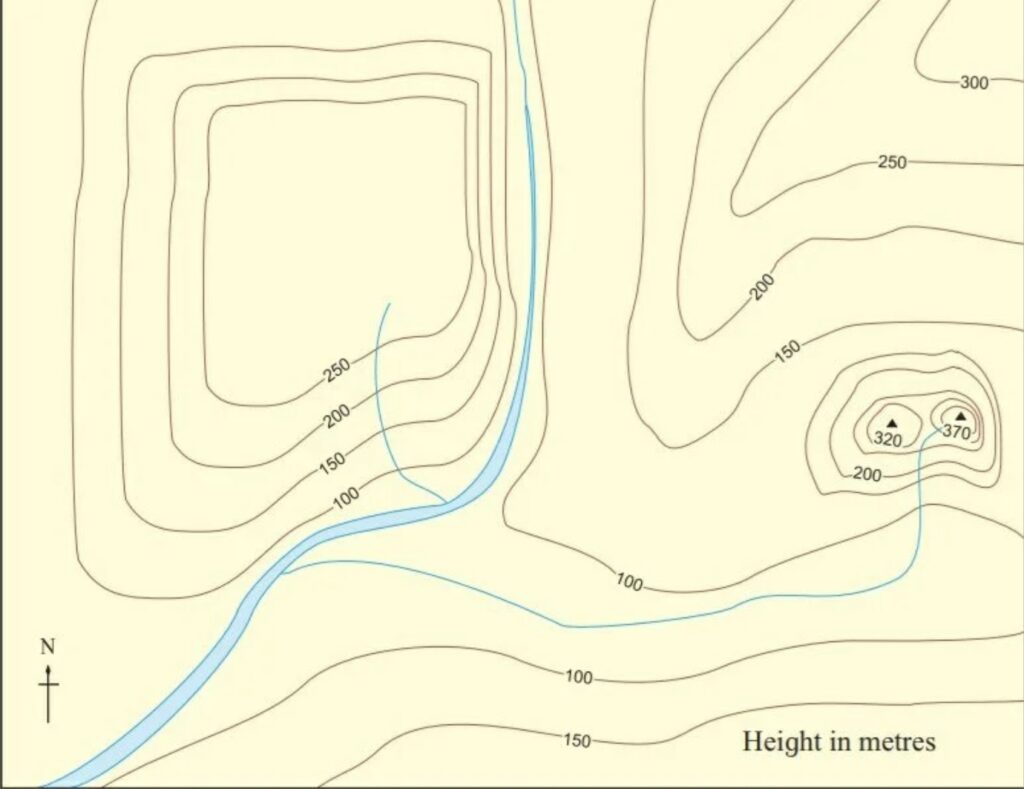
Ans: The landforms shown in the map are:
Plateau
Plains
Mountainous regions
Peak
Valley