
Maharashtra State Board
📘 Standard VIII – Science
Chapter 18: Ecosystems
✏️ 1. Complete the following by using the correct option.
a. Air, water, minerals, soil are __________ factors of an ecosystem.
(physical, organic, inorganic)
Ans: Physical
b. Rivers, ponds, and oceans are __________ ecosystems.
(land, aquatic, synthetic)
Ans: Aquatic
c. Man is a __________ in an ecosystem.
(producer, consumer, decomposer)
Ans: Consumer
🔗 2. Match the following
| Producers | Ecosystem |
|---|---|
| a. Cactus | 4. Desert |
| b. Aquatic plants | 3. Aquatic |
| c. Mangroves | 2. Creek |
| d. Pine | 1. Forest |
📚 3. Give My Information
a. Ecosystem
Ans:
- An ecosystem is formed by biotic (producers, consumers, decomposers) and abiotic (air, soil, water, sunlight) factors and their interactions.
- Biotic factors affect abiotic factors and other biotic factors in the ecosystem.
- Abiotic factors determine which organisms can survive in a particular ecosystem.
- Different ecosystems are found on Earth depending on size, place, climate, and types of plants and animals (e.g., forest, pond, ocean, river).
- Though ecosystems may appear independent, they are interconnected directly or indirectly.
b. Biome
Ans:
- Large ecosystems developed in regions with similar climate and similar biotic and abiotic factors are called biomes.
- A biome contains many small ecosystems.
- There are two main types of biomes:
- Land biomes
- Aquatic biomes
- Land biomes include grasslands, evergreen forests, deserts, Taiga ecosystem, etc.
- Aquatic biomes cover about 71% of the Earth’s surface and include freshwater and marine ecosystems such as ponds, rivers, lakes, and oceans.
c. Food Web
Ans:
- An ecosystem consists of many interconnected food chains forming a complex network called a food web.
- In a food web, organisms are interdependent.
- Any change in the number of organisms at one level affects the entire food web.
🔬 4. Give Scientific Reasons
a. Plants in an ecosystem are called producers.
Ans:
- Plants can prepare their own food by photosynthesis using sunlight, carbon dioxide, and water.
- Producers are organisms that make their own food.
- Consumers depend directly or indirectly on plants for food.
- Therefore, plants are called producers in an ecosystem.
b. Large dams destroy ecosystems.
Ans:
- Dams are constructed across rivers to store water for irrigation and electricity generation.
- Forests and grasslands are cleared to build dams.
- Land ecosystems get submerged under water and are destroyed.
- Reduced water flow in downstream areas also affects local ecosystems.
c. Rhinos were restored in Dudhwa Forest.
Ans:
- About 150 years ago, one-horned rhinos lived in Dudhwa Forest.
- Due to excessive hunting, they nearly became extinct.
- Rhinos were bred in protected grasslands with adequate water supply.
- On April 1, 1984, the population of one-horned rhinos was successfully restored.
📝 5. Answer the Following
a. What are the effects of increased population on ecosystems?
Ans:
- Depletion of natural resources: Increased demand leads to overuse of resources.
- Loss of biodiversity: Forests and wetlands are destroyed for development.
- Increase in pollution: More fossil fuel use and waste generation increase pollution.
- Global warming: Increased CO₂ emissions raise global temperatures.
b. How is urbanization responsible for the destruction of ecosystems?
Ans:
- Urbanization means the movement of people from rural to urban areas.
- Forests, wetlands, and grasslands are cleared for buildings and roads.
- Transport infrastructure destroys natural habitats.
- Many species become endangered or extinct due to human interference.
c. What are the reasons for war?
Ans:
- Competition over land, water, minerals, and political reasons causes war.
- Wars involve heavy bombing and explosions.
- Natural ecosystems are permanently damaged or destroyed.
- Wars negatively affect both the environment and human life.
d. Explain the interactions among the factors of an ecosystem.
Ans:
- An ecosystem includes biotic and abiotic factors that interact continuously.
- Abiotic factors like sunlight, water, and soil support producers.
- Producers prepare food and pass energy to consumers.
- Decomposers break down dead plants and animals and recycle nutrients.
- The removal of any factor can disturb the food chain and ecosystem balance.
e. Differentiate between Evergreen Forests and Grasslands.
| Evergreen Forests | Grasslands |
|---|---|
| Found in areas with heavy rainfall throughout the year. | Found in areas with low to moderate rainfall. |
| Trees are dense and tall. | Mostly grasses with few trees and shrubs. |
| Leaves are broad and green. | Leaves are thin and narrow. |
| Trees do not shed all leaves at once. | Grasslands dry during the dormant season. |
🖼 6. Describe the Following Pictures
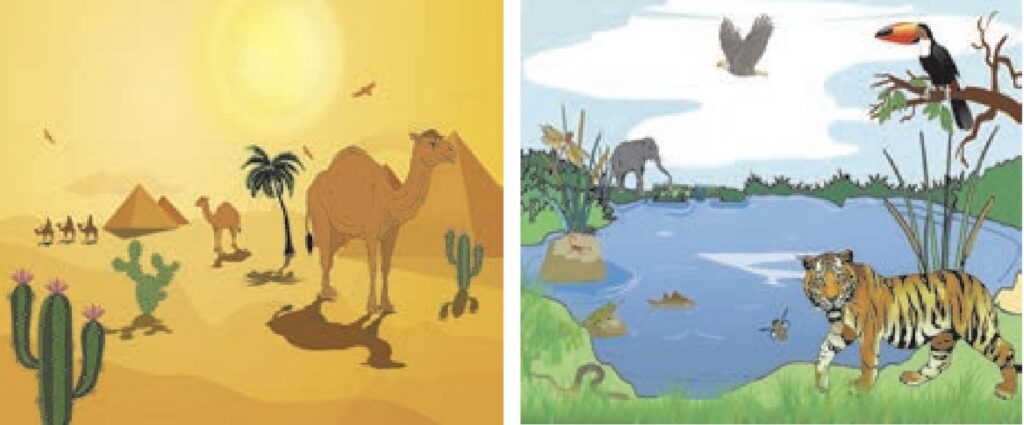
Ans:
- The picture represents a desert ecosystem.
- Deserts receive less than 25 cm of rainfall annually.
- Animals like camels have adaptations to survive with less water.
- Plants such as cactus and desert palm trees are found here.
- Many desert animals are nocturnal and live in burrows during the day.