
🇮🇳 Std 10 English – Chapter 1.3: On Wings of Courage
📘 Maharashtra Board – Complete Solutions
✨ 📖 Summary of the Lesson
The lesson highlights the life and achievements of Air Force Marshal Arjan Singh. He was born on April 15, 1919, and completed his education at Montgomery. He began his career by flying Westland Wapiti biplanes in the North-West Frontier Province.
He played an important role in the Arakan and Imphal campaigns and showed great courage during the Indo-Pak War of 1965. He was awarded the Distinguished Flying Cross (DFC) in 1944.
He led a historic fly-past of more than 100 aircraft over the Red Fort on August 15, 1947. He rose to the highest rank of Marshal of the Air Force in 2002.
After retirement, he served as Ambassador to Switzerland and Lieutenant Governor of Delhi. He is remembered as a brave and inspiring leader.
📘 Warming Up!
1. The ranks of officers in the Indian Army, Navy and Air Force are jumbled up. Discuss with your group and put them in the appropriate boxes.
Ans:
| ARMY | NAVY | AIR FORCE |
|---|---|---|
| Field Marshal | Admiral of Fleet | Air Marshal |
| Lieutenant General | Vice Admiral | Air Commodore |
| Brigadier | Rear Admiral | Wing Commander |
| Colonel | Commodore | Squadron Leader |
| Major | Commander | Flying Officer |
2. Homophones / Homographs
(A) Make sentences to bring out the difference between –
(1) (a) wear
Ans: We wear cotton clothes in summer.
(b) ware
Ans: He sells his wares in the weekly market.
(2) (a) here
Ans: She waited here for a long time.
(b) hear
Ans: Speak softly or they will hear us.
(3) (a) there
Ans: Sheena was standing there yesterday.
(b) their
Ans: Their farmhouse is near a river.
(4) (a) cell
Ans: The consumer cell is solving the issue.
(b) sell
Ans: They sell cookies in the shop.
(B) Write what the underlined Homographs in the following sentences mean.
(1) (a) A bear is an omnivorous animal.
Ans: Name of an animal.
(b) She could not bear the injustice.
Ans: To tolerate.
(2) (a) A bat is the only bird which is a mammal.
Ans: Name of an animal.
(b) His bat broke as it struck the ball.
Ans: A sports equipment used to hit the ball.
(3) (a) He had to pay a fine for breaking the traffic signal.
Ans: A penalty or money paid as punishment.
(b) Use a fine cloth for the baby’s clothes.
Ans: Good quality or soft.
(4) (a) We enjoyed a lot at the temple fair.
Ans: A public gathering or event.
(b) She has a fair complexion.
Ans: Light-coloured complexion.
📖 In Between the Lesson
Q1. Why is Air Force Marshal Arjan Singh considered an outstanding military personality?
Ans: Air Force Marshal Arjan Singh is considered an outstanding military personality because he successfully led the Indian Air Force during the Indo-Pak War of 1965. He also flew more than 60 types of aircraft and inspired many personnel of the Armed Forces through his leadership and dedication.
Q2. What personality traits of Arjan Singh are mentioned here?
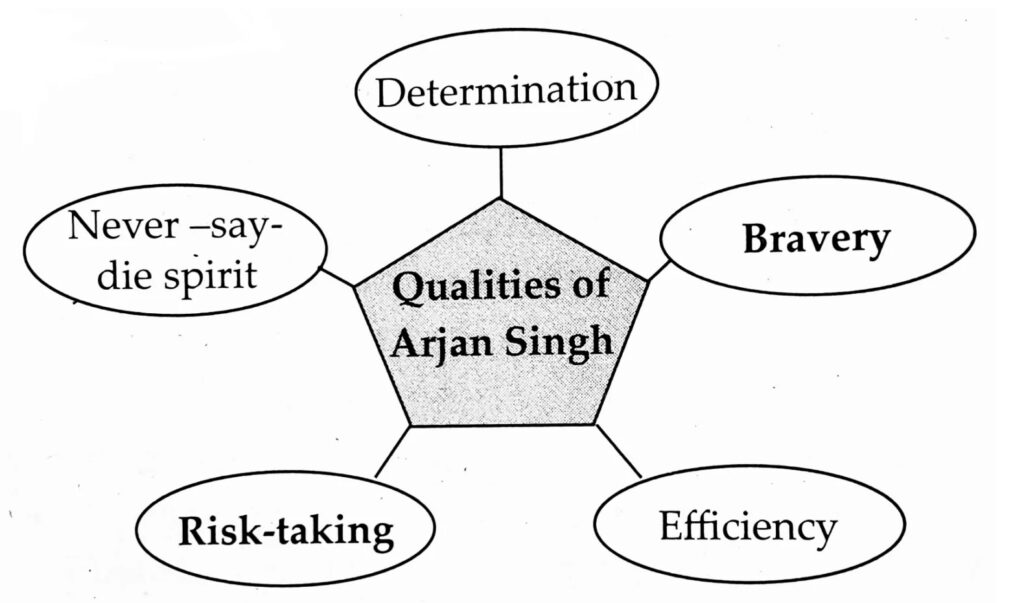
Ans: The personality traits mentioned are leadership, courage, foresight, determination, fearlessness, and a strong sense of duty towards the nation.
Q3. What enabled Arjan Singh to win the DFC award?
Ans: Arjan Singh led a squadron against the Japanese during the Arakan Campaign in 1944 and supported the Allied Forces, which enabled him to win the Distinguished Flying Cross (DFC).
Q4. At what age did Arjan Singh become a Squadron Leader?
Ans: Arjan Singh became a Squadron Leader at the age of 25.
Q5. For how long did Arjan Singh hold the post of AOC?
Ans: Arjan Singh held the post of Air Officer Commanding for about seven years.
Q6. What uphill task did Singh face when he took over as Air Marshal?
Ans: When Arjan Singh took over as Air Marshal, he faced the difficult task of rebuilding the Indian Air Force and preparing it to meet new challenges.
Q7. What other important positions did Arjan Singh hold after his retirement?
Ans: After his retirement, Arjan Singh served as the Ambassador to Switzerland and later as the Lieutenant Governor of Delhi.
📝 English Workshop
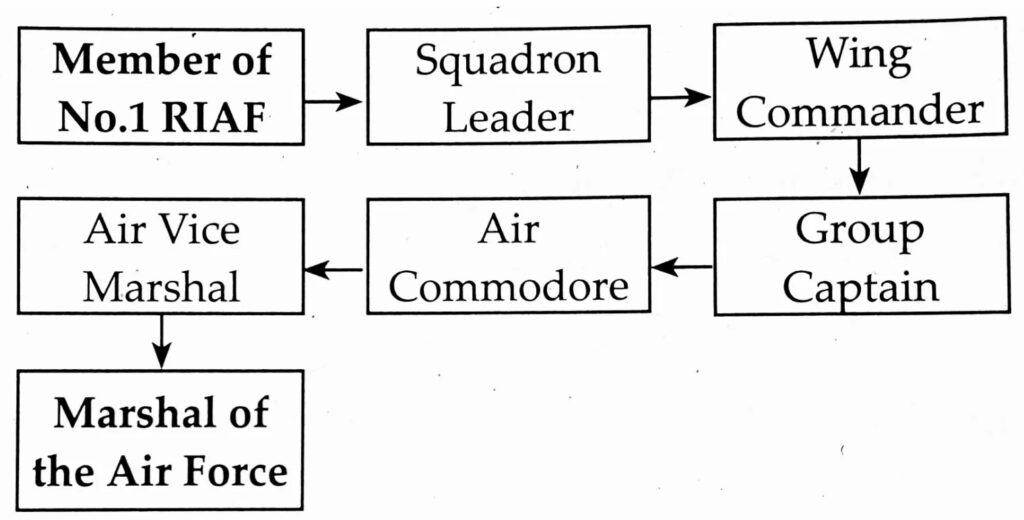
1. Read the text and fill in the flow chart of the promotions received by Arjan Singh.
2. With the help of facts given in the text prepare a Fact file of Air Marshal Arjan Singh.
Ans:
- Date of Birth: April 15, 1919
- Place of Birth: Lyalpur (now Faisalabad, Pakistan)
- Education: Montgomery (now Sahiwal, Pakistan)
- First Assignment:
To fly Westland Wapiti biplanes in the North-West Frontier Province as a member of No. 1 RIAF Squadron - Important Posts Held in Air Force:
Squadron Leader, Wing Commander, Group Captain, Air Commodore, Air Vice Marshal, Marshal of the Air Force - After Retirement:
Ambassador to Switzerland, Lieutenant Governor of Delhi - Awards:
Distinguished Flying Cross (1944), Padma Vibhushan - Contribution:
He transformed the Indian Air Force into a powerful force and led it to victory in the 1965 war - Retirement: August 1969
3. Fill in the web.
4. Say what actions preceded the following promotions of Arjan Singh in his career in the IAF.
(a) Selected for Empire Pilot training course at RAF
Ans: Arjan Singh completed his education at Montgomery before being selected.
(b) Promoted to Squadron Leader
Ans: He successfully carried out missions against tribal forces.
(c) Leader of a flypast of over 100 aircrafts at Red Fort, Delhi
Ans: He demonstrated excellent leadership and flying skills in combat.
(d) Awarded Padma Vibhushan
Ans: He displayed outstanding leadership during the Indo-Pak War of 1965.
(e) First Air Chief Marshal of Indian Air Force
Ans: His leadership helped strengthen and modernize the Indian Air Force.
5. Replace the underlined words/phrases with the appropriate ones.
(a) He played a major role in bringing up the school.
(b) Our school team geared up for the final match.
(c) After a brief stint as a lecturer, Ravi joined a company.
(d) Our class monitor is the epitome of discipline.
(e) In recognition of his research, he was awarded a Ph.D.
(f) Macbeth took over the reins of Scotland.
7. (A) State the different meanings of the following pairs of Homophones and make sentences of your own with each of them.
| Word | Meaning | Sentence |
|---|---|---|
| led | Past tense of lead (to guide) | The captain led the team to victory. |
| lead | To guide / a type of metal | She will lead the group in the project. |
| role | A part played by a person | She played an important role in the play. |
| roll | To move by turning / a small bread | The ball began to roll down the hill. |
| air | The invisible gas we breathe | Fresh air is good for health. |
| heir | A person who inherits property | He is the heir to his father’s property. |
| feat | An achievement | Climbing the mountain was a great feat. |
| feet | Plural of foot | My feet are tired after walking. |
| reign | Rule of a king or queen | The king’s reign lasted for many years. |
| rein | A strap used to control a horse | Hold the reins tightly while riding. |
| rain | Water falling from clouds | It started to rain heavily in the evening. |
✍️ Story Writing
Develop a story suitable to the conclusion given below. Suggest a suitable title.
Title: Little Hands, Great Deeds
In a small village named Achalpur, there lived a hardworking farmer Vilasrao More with his wife Sushobhana and their two children, Sanyogita and Sahil. Sanyogita was a brave and intelligent girl studying in Class 5, while Sahil was younger and studied in Class 2.
One day, their father had gone to the market, and their mother told Sanyogita to take care of Sahil and come home directly after school. After school, both children were returning home happily. On the way, Sahil felt hungry, so Sanyogita bought some peanuts for him.
Suddenly, they noticed smoke coming from a nearby house and heard cries for help. Without wasting time, Sanyogita rushed inside and saw a fire spreading in the kitchen. A woman and her small child had fainted.
Showing great courage, Sanyogita quickly took action. She threw mud on the fire and controlled it. Then she used a sack to stop the fire from reaching the gas cylinder. Her presence of mind saved the house from a major disaster.
People around were amazed at her bravery. The woman and her child were saved. Sanyogita quietly returned home without telling anyone.
The next day, the village head came to her house and praised her bravery. Her parents felt proud of her.
Later, on Republic Day, Sanyogita was invited to Delhi and honoured with the National Bravery Award by the Prime Minister.
And so, with tears of joy and pride, the 10-year-old Sanyogita More received the National Bravery Award from the Prime Minister.