
Maharashtra State Board
Standard VII – Science
Chapter 16 – Natural Resources
1. Describe natural resources with reference to the following three types.
(a) Mineral Resources
Ans: Mineral resources are natural resources found in the earth’s crust and obtained through mining. Some minerals such as gold, silver, platinum, and bismuth are found in their free state. Other minerals such as iron, aluminium, and mica occur in a mixed form called ores. These ores are processed and purified to obtain metals and non-metals.
In addition to metals, there are precious minerals such as diamond, ruby, emerald, jade, and zircon which are used as gemstones. Coal, petroleum, and natural gas are also mineral resources and are widely used as fuels. Transportation and electricity production largely depend on these mineral resources.
(b) Forest Resources
Ans: A large area of land covered with a variety of plants and trees is called a forest. Forests serve as natural habitats for plants, animals, and microorganisms. Nearly 30% of the earth’s land area is covered with forests.
Forests perform many protective and productive functions:
(i) They reduce the speed of water flowing over the land.
(ii) They help in preventing soil erosion.
(iii) They help water to seep into the ground.
(iv) They help in controlling floods.
(v) They reduce the rate of evaporation.
(vi) They provide shelter to wildlife.
(vii) They help maintain the balance of atmospheric gases.
Thus, forests help protect biodiversity and maintain environmental balance.
(c) Ocean Resources
Ans: Oceans are an important source of natural resources. Energy can be generated from ocean waves, tides, and ocean currents.
The seabed and ocean floor also contain many valuable minerals and fuels. All the resources obtained from seas and oceans are called ocean resources.
2. Write answers to the following questions in your own words.
(a) What is meant by fossil fuel? What are their types?
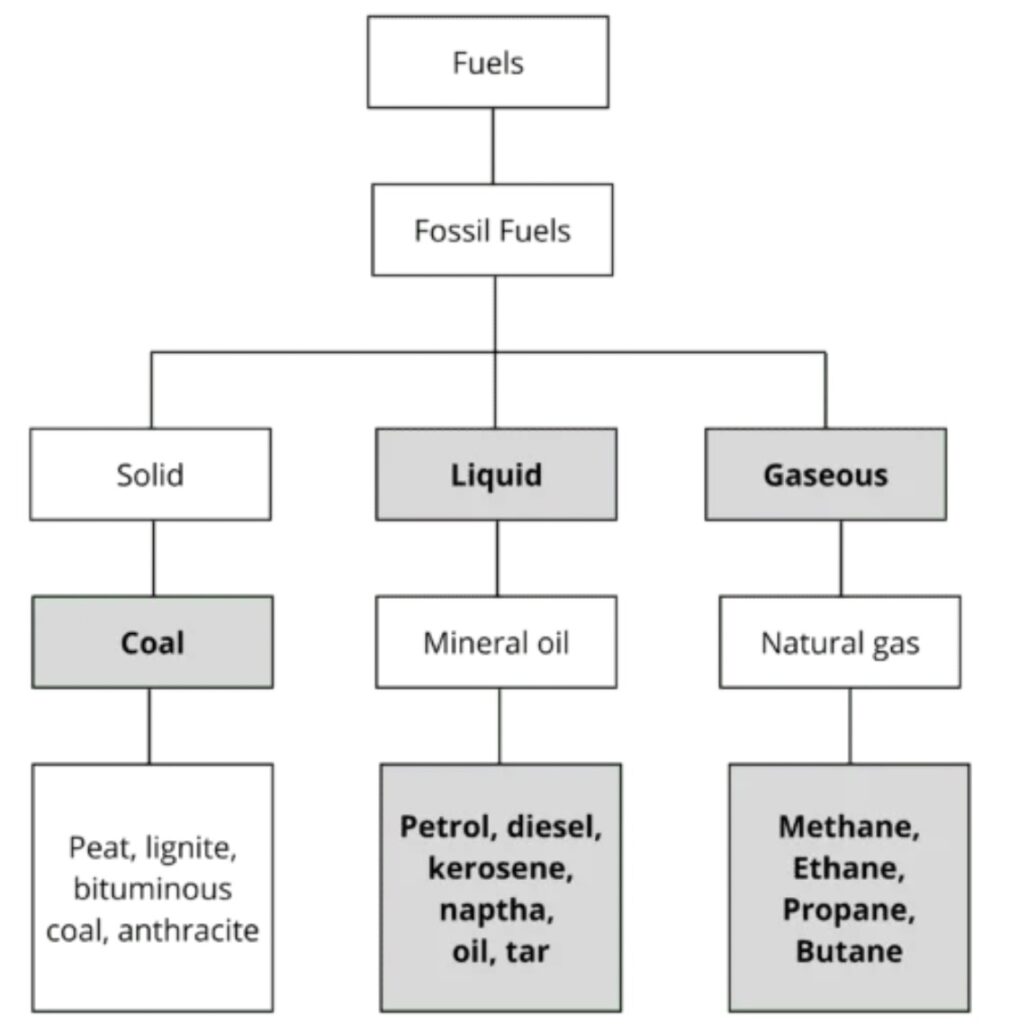
Ans: Fossil fuels are fuels formed from the remains of plants and animals that were buried deep inside the earth millions of years ago. Due to high pressure and temperature inside the earth, these remains slowly turned into fuels.
The main types of fossil fuels are:
(i) Coal
(ii) Petroleum (crude oil)
(iii) Natural gas
(b) Make a list of the components we obtain from mineral oil.
Ans: Crude mineral oil is a mixture of many hydrocarbon compounds. After refining, several useful products are obtained from it, such as:
(i) Petrol
(ii) Diesel
(iii) Kerosene
(iv) Aviation fuel
(v) Naphtha
(vi) Lubricating oil
(vii) Tar
(c) What do we get from forests?
Ans: Forests provide many useful products such as:
(i) Wood used for building houses and making furniture.
(ii) Farming tools and household articles.
(iii) Paper and fibres from cellulose.
(iv) Rubber, gum, and aromatic substances.
(v) Fruits, roots, and medicinal plants.
(vi) Dyes, resins, and other natural substances.
(d) What are the items included in ocean resources? What are their uses?
Ans: Ocean resources are of two types: non-living resources and living resources.
A) Non-living resources
(i) Minerals such as thorium, uranium, magnesium, potassium, iodine, and common salt.
(ii) Fossil fuels such as crude oil and natural gas.
Uses:
- Thorium and uranium are used to produce atomic energy and electricity.
- Oil and natural gas are used as fuels in industries and vehicles.
B) Living resources
(i) Fish
(ii) Dried shrimp
(iii) Bombay duck powder
(iv) Shells
(v) Shark
(vi) Codfish
(vii) Sea cucumbers
Uses:
- Fish provide protein-rich food.
- Fish liver oil contains vitamins A and D.
- Dried fish powder is used as poultry feed.
- Shells are used to make decorative items.
- Sea cucumbers are used in medicines.
(e) Why should we prevent the wastage of fuel used for vehicles?
Ans: Petrol and diesel used in vehicles are fossil fuels formed over millions of years through geological processes. Their reserves are limited and may get exhausted in the future.
When these fuels burn in vehicle engines, they release harmful gases that cause air pollution. Therefore, it is important to prevent the wastage of fuel and use it carefully.
(f) Why is the diversity of plants and animals in forests declining?
Ans:
(i) Decline in plant diversity
Due to the increasing human population, more land is required for housing, farming, and industries. Forests are cut down for these purposes. In some places, only a few useful plants are grown, which reduces the natural variety of plants in forests.
(ii) Decline in animal diversity
Hunting and poaching reduce animal populations. When plant diversity decreases, animals lose their food and shelter, which further reduces wildlife diversity.
(g) Write the names of five minerals and the useful substances obtained from them.
Ans:
| Mineral | Useful Substance / Use |
|---|---|
| Iron | Used to make steel for machinery, railway tracks, tools, needles, and pins. |
| Magnesium | Used in medicines, electrical appliances, and glass production. |
| Bauxite | Used to obtain aluminium, which is used in electric wires and aircraft. |
| Copper | Used to make electric wires, utensils, vehicles, and statues. |
| Mica | Used in electrical equipment, medicines, and dyes. |
(h) Name the two important stages in the process of obtaining metals from ores.
Ans: The two important stages in obtaining metals from ores are:
(i) Extraction
(ii) Purification
3. What steps are taken for protection and conservation of natural resources?
Ans: Natural resources are necessary for fulfilling human needs, but many of them are limited. Excessive use may lead to their depletion. Therefore, it is important to conserve and use natural resources wisely.
We should reduce wastage, recycle materials, plant more trees, and use renewable sources of energy. These steps help protect and conserve natural resources for future generations.
4. Complete the flow chart.
Ans:
5. How does the economic condition of a nation depend on its natural resources?
Ans: Natural resources play an important role in the economic development of a nation. Minerals and ores provide raw materials for industries that manufacture goods and equipment. Oil and natural gas provide energy resources.
Forests supply timber and many other products. Oceans provide food, transport routes, and useful chemicals. All these resources help create wealth, generate employment, and improve the income of citizens. Therefore, the economic condition of a nation depends greatly on its natural resources.
6. Which medicinal plants will you grow on your school premises and near your house? Why?
Ans: Medicinal plants such as neem, ashwagandha, asparagus, adulsa, amla, periwinkle, tulsi, turmeric, and ginger can be grown near the school premises and around our homes. These plants are easy to grow and have many medicinal uses. They help in treating common illnesses and are very useful for maintaining good health.