
Maharashtra State Board – Standard IX
Science
Chapter 18 – Observing Space: Telescopes
🔹 1. Fill in the blanks with the proper words.
1. The wavelength of visible light is between …….. and ………
Ans: The wavelength of visible light is between 400 nm and 800 nm.
2. GMRT is used for ……. waves.
Ans: GMRT is used for radio waves.
3. A certain X-ray telescope is named after scientist ………..
Ans: A certain X-ray telescope is named after scientist Subramanian Chandrashekhar.
4. The first scientist to use a telescope for space observation was ………………. .
Ans: The first scientist to use a telescope for space observation was Galileo Galilei.
5. The biggest optical telescope in India is situated at ……….
Ans: The biggest optical telescope in India is situated at the Aryabhatta Research Institute of Observational Sciences (ARIES), Nainital.
🔹 2. Form pairs
| ‘A’ Group | ‘B’ Group |
|---|---|
| (i) X-rays | (d) Chandra |
| (ii) Optical Telescope | (c) Hubble |
| (iii) Indian radio telescope | (a) GMRT |
| (iv) Launching artificial satellites | (b) ISRO |
Ans: The correct pairs are as shown in the table above.
🔹 3. What are the difficulties in using ground based optical telescopes? How are they overcome?
Ans: Difficulties:
- The visible light coming from heavenly bodies has to pass through the Earth’s atmosphere before reaching the surface.
- During this journey, some of the light is absorbed by the atmosphere, reducing its intensity.
- Changes in atmospheric pressure and temperature cause turbulence in the atmosphere.
- This turbulence changes the path of light rays slightly and makes the image appear shaky.
- Optical telescopes cannot be used during the day because of bright sunlight.
- At night, city lights and cloudy weather also create difficulties in observation.
Solutions:
- To reduce these problems, optical telescopes are located on mountains in uninhabited places where the air is thin and clear.
- To completely avoid atmospheric disturbances, telescopes are placed in space above the Earth’s atmosphere.
🔹 4. Which type of telescopes can be made using a concave mirror, convex mirror, plane mirror and a lens? Draw diagrams of these telescopes.
Ans:
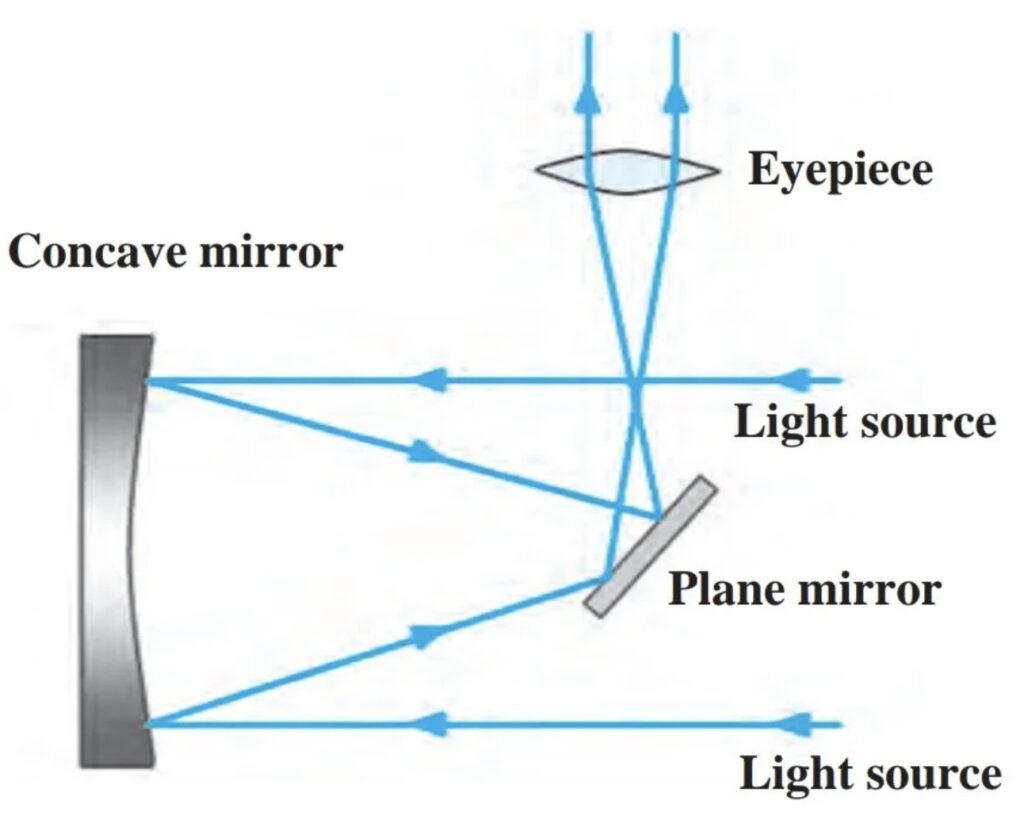
- A Newtonian telescope can be made using a concave mirror, a plane mirror, and a lens (eyepiece).
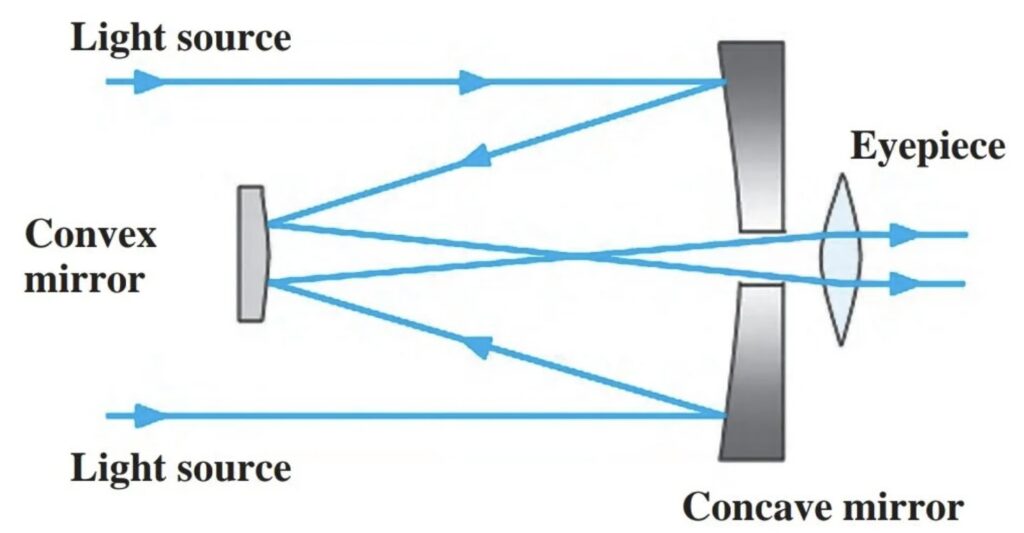
- A Cassegrain telescope can be made using a concave mirror, a convex mirror, and a lens.
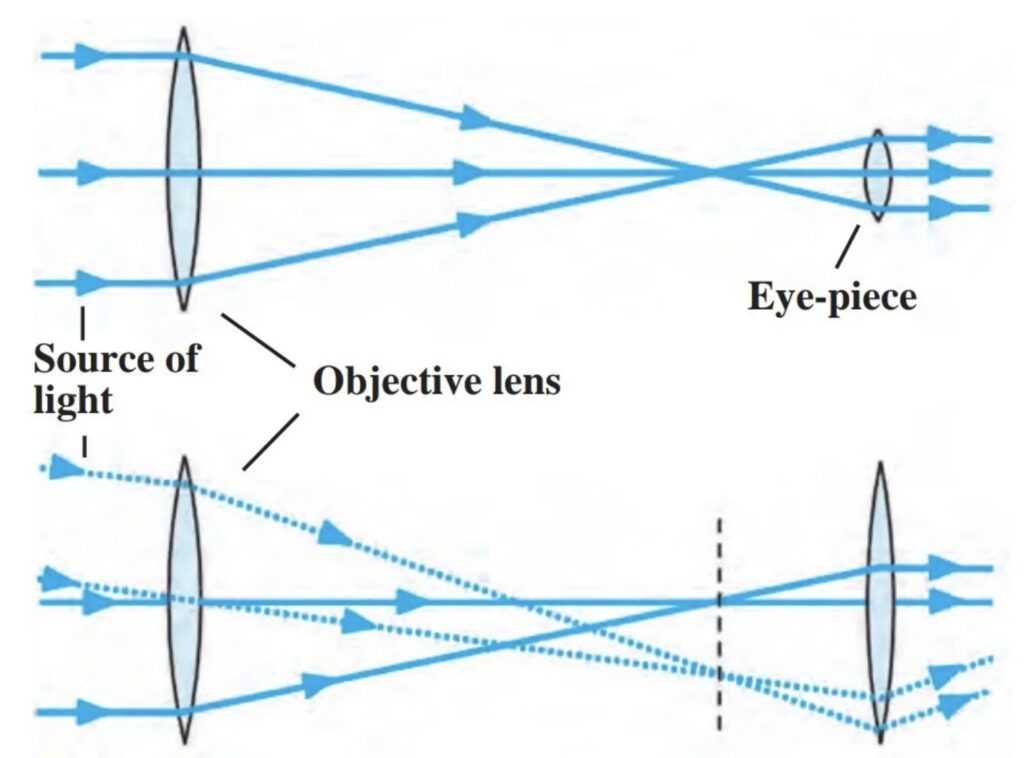
- A Refracting telescope is made using two or more lenses.
🔹 5. Study the figure and answer the following questions:
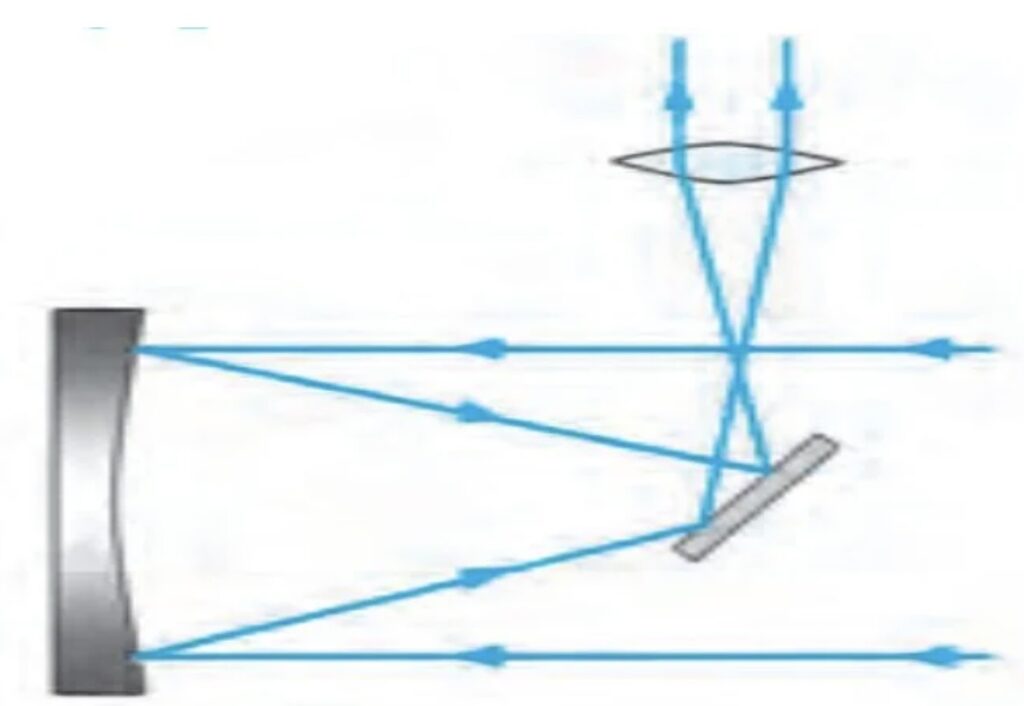
a. What type of telescope is shown in the figure?
Ans: The telescope shown in the figure is a Newtonian telescope (reflecting telescope).
b. Label the main parts of the telescope.
Ans: The main parts of the telescope are:
- Concave mirror
- Plane mirror
- Eyepiece
- Tube of the telescope
- Incoming light rays
c. Which type of mirror does the telescope use?
Ans: The telescope mainly uses a concave mirror.
d. What other type of telescope uses a curved mirror?
Ans: The Cassegrain telescope also uses a curved mirror.
e. Explain the working of the above telescope.
Ans:
- Light rays coming from a distant object fall on the concave mirror.
- The concave mirror reflects the light rays towards its focus.
- Before the rays meet at the focus, a small plane mirror deflects them sideways.
- The light rays then pass through the eyepiece.
- A magnified image of the object is formed, which we can observe.
🔹 6. Answer the following questions.
a. Explain the construction of Galileo’s telescope.
Ans:
- Galileo’s telescope is made using two lenses.
- The lens facing the object is called the objective lens, and it is large to collect maximum light.
- The lens near the eye is called the eyepiece.
- The objective lens forms an image, and the eyepiece magnifies it.
- This type of telescope is called a refracting telescope.
b. Explain the construction of a radio telescope.
Ans:
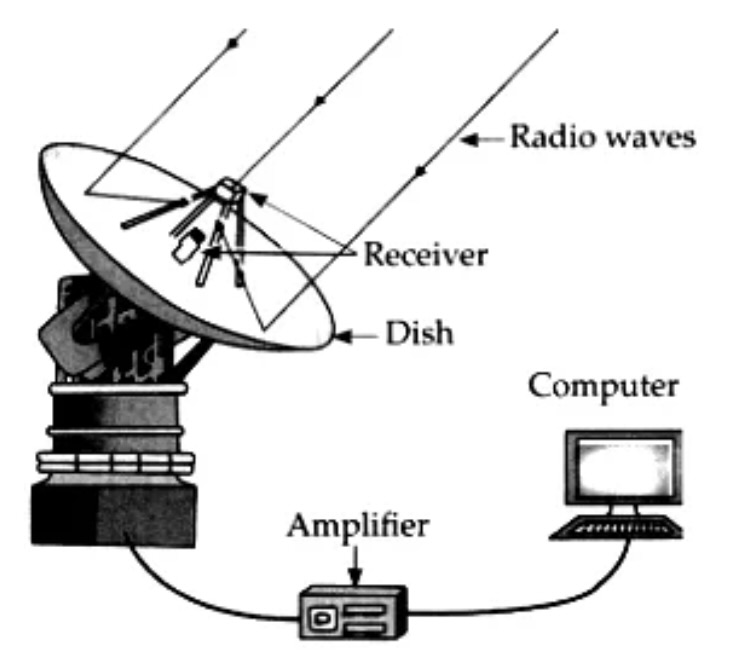
- A radio telescope consists of one or more large parabolic dishes.
- The radio waves coming from space are reflected by the dish.
- These waves converge at the focus of the dish.
- A radio receiver placed at the focus collects the signals.
- The collected information is sent to a computer, which processes it and forms an image of the source.
c. Why are optical telescopes located in uninhabited places on mountains?
Ans:
- Light from heavenly bodies gets absorbed and scattered by the atmosphere.
- Atmospheric turbulence causes images to appear unsteady.
- Sunlight during the day prevents observation.
- At night, city lights and pollution affect visibility.
- Therefore, optical telescopes are placed on high mountains in uninhabited areas where the air is clear and pollution is minimal.
d. Why can an X-ray telescope not be based on the Earth?
Ans:
- X-rays are emitted by distant heavenly bodies.
- The Earth’s atmosphere absorbs X-rays before they reach the surface.
- Therefore, X-ray telescopes must be placed in space above the Earth’s atmosphere to detect these rays.