
Maharashtra State Board – Standard IX
Chapter 7 – International Date Line (IDL)
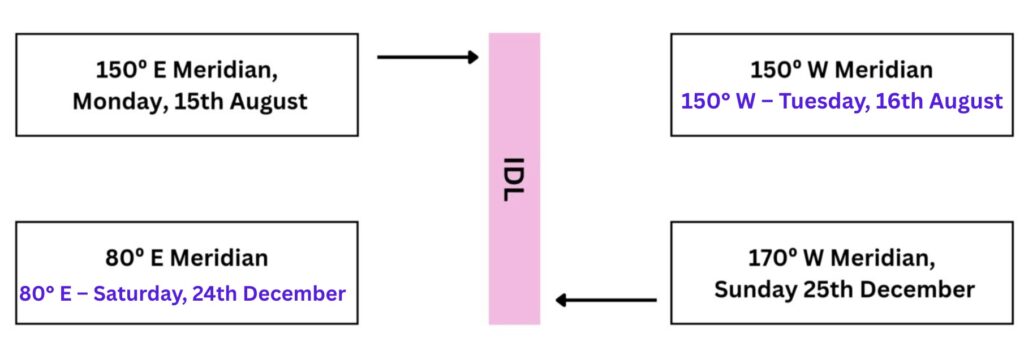
Q.1) Two boxes in different hemispheres are given in the diagram. The IDL passes through both the boxes. In one box, the meridian, day and date are given. Find the day and date for the other box.
Ans:
While solving this question:
- If we move from East to West across the IDL, we add one day.
- If we move from West to East across the IDL, we subtract one day.
Q.2) Select the correct option:
(1) While crossing the IDL, a person will have to add one day when travelling from –
(a) East to West
(b) West to East
(c) South to North
(d) North to South
Ans: (a) East to West
(2) If it is Wednesday 10 a.m. at 150° E meridian, then what will be the time at IDL?
(a) Wednesday 6 a.m.
(b) Wednesday 9 p.m.
(c) Thursday 2 p.m.
(d) Thursday 6 p.m.
Ans: (b) Wednesday 9 p.m.
(3) According to the international convention, at which meridian does the day and date change occur?
(a) 0°
(b) 90° E
(c) 90° W
(d) 180°
Ans: (d) 180°
(4) In which direction of the IDL does a new day start immediately?
(a) East
(b) West
(c) North
(d) South
Ans: (b) West
(5) IDL brings coordination in which of the following?
(a) GPS system
(b) Defence departments
(c) Transportation schedules
(d) Determining the hemisphere
Ans: (c) Transportation schedules
Q.3) Give geographical reasons.
(1) IDL is proving to be very useful in today’s times.
The International Date Line is very useful today because:
- It helps in coordinating international airways and transportation services.
- It maintains uniformity in trade and economic activities.
- It ensures proper calculation of time and date worldwide.
- It helps organise global travel schedules accurately.
- Without the IDL, international time management would become confusing.
(2) The day starts in the Pacific Ocean on the Earth.
- The IDL passes mainly through the Pacific Ocean.
- A new day begins immediately to the west of the IDL.
- Countries located west of the IDL (such as Japan and Australia) experience the new day first.
- Countries east of the IDL (such as the USA and Chile) are still in the previous day.
Therefore, a new day starts in the Pacific Ocean.
Q.4) Write in brief:
(1) What considerations have been made while deciding the IDL?
- The IDL was agreed upon in 1884.
- It is based on the 180° meridian.
- The direction of travel is considered while crossing it.
- The change in date while crossing it is carefully observed.
- It avoids passing through major land masses.
(2) While crossing the IDL, what changes will you make?
- While travelling from East to West, one day is added to the date.
- Example: If it is 25th December in America, it becomes 26th December in Japan.
- While travelling from West to East, one day is subtracted from the date.
- Example: If it is 26th December in Japan, it becomes 25th December in America.
(3) Why is the IDL not a straight line like the 180° meridian?
- The IDL avoids passing through countries and islands.
- If it passed through land, people in the same country would have different dates.
- This would create confusion in daily life and administration.
- Therefore, the IDL bends east or west at some places but mostly follows the 180° meridian.
(4) Why doesn’t the IDL pass through land?
- To avoid confusion of different dates within the same country.
- To prevent administrative and social difficulties.
- To ensure smooth coordination of time and date.
- Hence, it mainly passes through the Pacific Ocean.
(5) Why is the IDL considered with respect to the 180° meridian only?
- The Earth rotates from west to east.
- Midnight occurs at different times at different places.
- The 180° meridian lies opposite the Greenwich Prime Meridian (0°).
- Therefore, the IDL was fixed near the 180° meridian to mark the change of date clearly.
Q.5) Using an atlas, tell in which of the following routes the IDL will be crossed.
(1) Mumbai – London – New York – Los Angeles – Tokyo
✔ IDL will be crossed.
(2) Delhi – Kolkata – Singapore – Melbourne
✘ IDL will not be crossed.
(3) Kolkata – Hong Kong – Tokyo – San Francisco
✔ IDL will be crossed.
(4) Chennai – Singapore – Tokyo – Sydney – Santiago
✔ IDL will be crossed.
(5) Delhi – London – New York
✘ IDL will not be crossed.