
Maharashtra State Board
Standard VIII – Science
Chapter 16: Reflection of Light
1. Fill in the Blanks
(i) The perpendicular to the mirror at the point of incidence is called __________.
Ans: Normal
(ii) The reflection of light from a wooden surface is __________ reflection.
Ans: Irregular
(iii) The working of a kaleidoscope is based on the property of __________.
Ans: Reflection of light
2. Draw a Figure and Answer
The reflecting surfaces of two mirrors make an angle of 90° with each other. If a ray incident on one mirror has an angle of incidence of 30°, draw the ray reflected from the second mirror. What will be its angle of reflection?
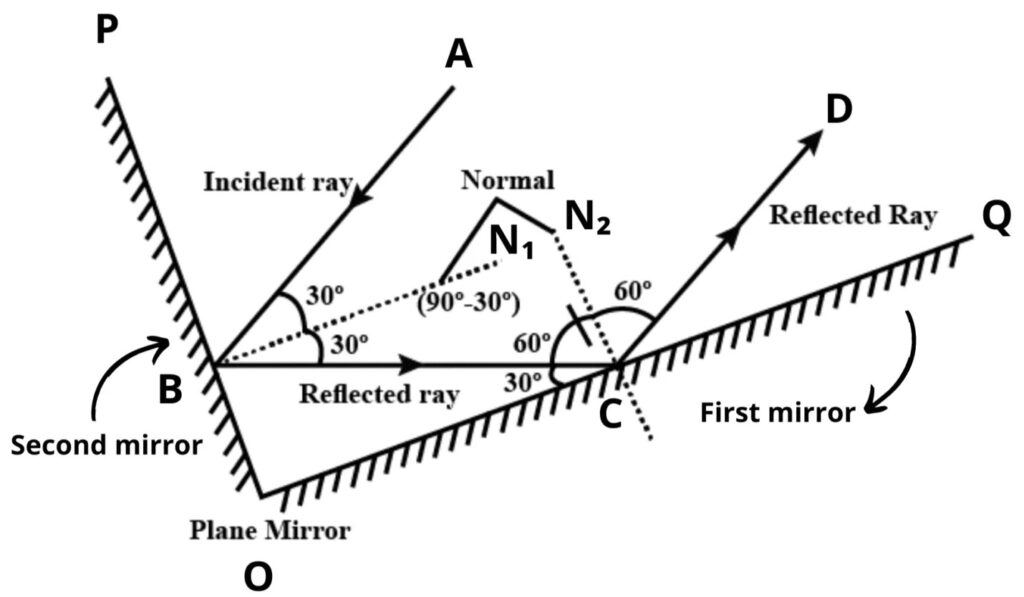
Ans: For the first mirror (PO):
- Ray AB – Incident ray
- Ray BC – Reflected ray
- ∠ABN₁ – Angle of incidence
- ∠CBN₁ – Angle of reflection
According to the law of reflection:
∠ABN₁ = ∠CBN₁ = 30°
For the second mirror (OQ):
- Ray BC – Incident ray
- Ray CD – Reflected ray
Since the mirrors are at 90° to each other:
∠BCN₂ = 90° − 30° = 60°
According to the law of reflection:
∠N₂CD = ∠BCN₂ = 60°
Answer: The angle of reflection from the second mirror is 60°.
3. How will you explain the statement: “We cannot see objects in a dark room”?
Ans:
(i) We can see objects only when light from them enters our eyes.
(ii) The light may be emitted by the object or reflected from it.
(iii) In a completely dark room, there is no light.
(iv) Therefore, no light reaches our eyes and we cannot see the objects.
4. Difference Between Regular and Irregular Reflection
| Regular Reflection | Irregular Reflection |
|---|---|
| Occurs on smooth surfaces. | Occurs on rough surfaces. |
| Reflected rays remain parallel. | Reflected rays scatter in different directions. |
| Clear images are formed. | Clear images are not formed. |
| Laws of reflection are followed. | Laws of reflection are followed. |
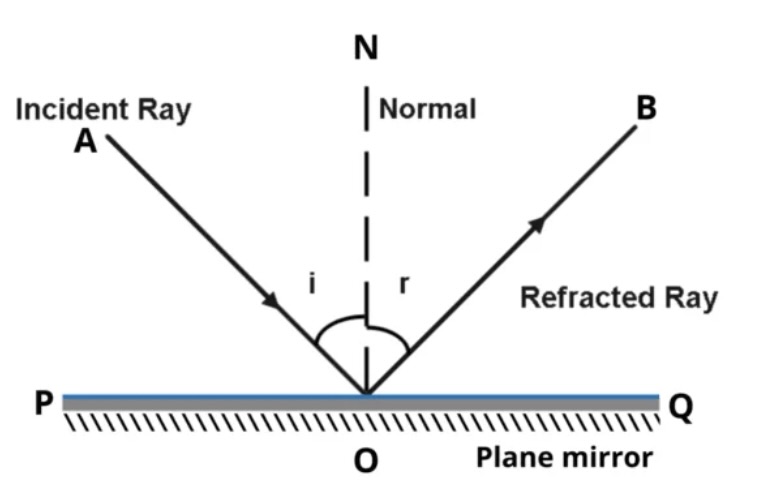
5. Draw a Figure Showing the Following
a. Incident ray
b. Normal
c. Angle of incidence
d. Angle of reflection
e. Point of incidence
f. Reflected ray
Ans (Labels):
- Ray AO – Incident ray
- Ray ON – Normal
- ∠AON – Angle of incidence
- ∠BON – Angle of reflection
- Point O – Point of incidence
- Ray OB – Reflected ray
6. Study the Following Incident
Swara and Yash saw their images clearly in still water. When Yash threw a stone, the images became blurred.
(i) Is there a relation between reflection of light and blurring of images?
Ans: Yes, there is a relation between reflection of light and blurring of images.
(ii) Which type of reflection is observed?
Ans:
When the water was still, regular reflection occurred because the surface was smooth.
When the stone was thrown, the surface became uneven, causing irregular reflection.
(iii) Are the laws of reflection followed?
Ans: Yes, the laws of reflection are followed in both regular and irregular reflection.
7. Solve the Following Examples
(a) If the angle between the plane mirror and the incident ray is 40°, what are the angles of incidence and reflection?
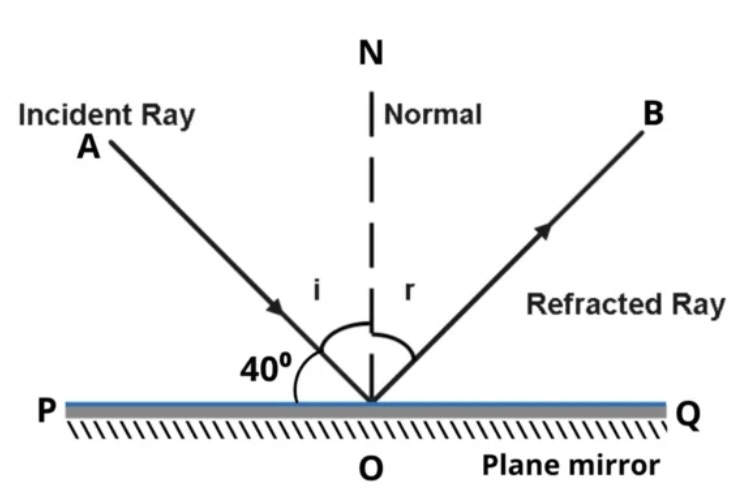
Given:
Angle between mirror and incident ray = 40°
Angle of incidence = 90° − 40° = 50°
According to the law of reflection:
Angle of reflection = 50°
Answer:
Angle of incidence = 50°
Angle of reflection = 50°
(b) If the angle between the mirror and the reflected ray is 23°, what is the angle of incidence?
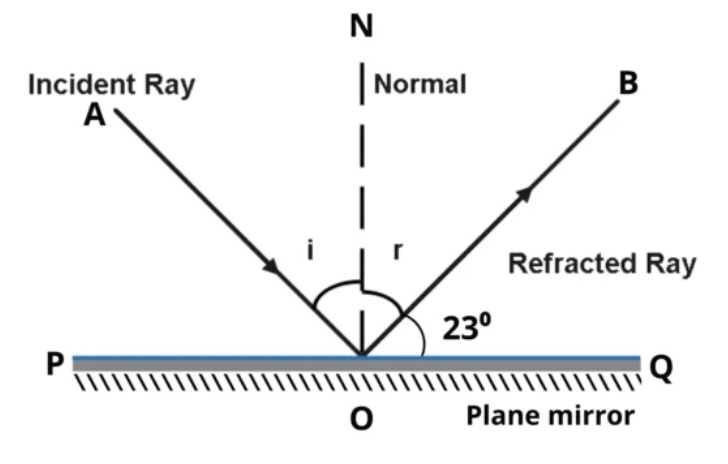
Given: Angle between mirror and reflected ray = 23°
Angle of reflection = 90° − 23° = 67°
According to the law of reflection:
Angle of incidence = 67°
Answer: The angle of incidence is 67°.