Chapter 10 – Human Settlements
Maharashtra Board Textbook Solutions for Standard Seven
Q.1. Answer in Short
1. Explain the various types of human settlements.
Ans: The various types of human settlements are:
- Scattered Settlements
- Nucleated Settlements
- Linear Settlements
1) Scattered Settlements
- Houses are found in areas of high relief, dense forests, grasslands, hot deserts, etc.
- Houses are far apart and the population is limited.
- Since these settlements are closer to nature, they are free from pollution.
- Facilities and services are not easily available here.
2) Nucleated Settlements
- These settlements develop close to water resources.
- Fertile plains, transport hubs, mining centres, and commercial centres help in their development.
- Social services and facilities are available here.
- People of different castes, religions, races, and ideologies live together, leading to better social life.
3) Linear Settlements
- These settlements develop along rivers, seacoasts, roads, or railways.
- Houses are arranged in a single line and may later grow into multiple lines.
- Roads are generally parallel to each other.
2. Differentiate between Nucleated and Scattered Settlements
| Nucleated Settlements | Scattered Settlements |
|---|---|
| Houses are close to each other. | Houses are far from each other. |
| They are close to water bodies like brooks, rivulets, lakes, etc. | They are found in areas of high relief, dense forests, grasslands, hot deserts, etc. |
| Social services are available here. | Facilities and services are not adequate. |
| Some pollution may be present due to transport hubs and mining centres. | These are closer to nature and are free from pollution. |
3. Explain the natural factors affecting the location of human settlements.
Ans:
Human settlements flourish in areas with favourable geographical conditions such as availability of water, suitable climate, and fertile land.
- People living along the seacoast are engaged in fishing, and their settlements become fishing hamlets.
- Forest dwellers or tribal people depend on forest products and live in tribal hamlets.
- Agriculture is practised in fertile regions, and farmers build their houses in or near their fields.
- Over time, such settlements gradually grow bigger.
4. Explain how human settlements have evolved.
Ans:
- Human beings started settlements by using resources from their surroundings. Settlements flourished in areas with favourable conditions such as water and fertile land.
- In early settlements, occupations depended on locally available natural resources. For example, people living near the sea became fishermen.
- In fertile areas, agricultural settlements developed near fields and gradually expanded. Agriculture and fishing are common occupations in rural settlements.
- With time, associated occupations developed, and people from nearby areas migrated, increasing the rural population.
- The growth of secondary and tertiary occupations led to the transformation of rural settlements into urban settlements.
5. Differentiate between a Hamlet and a Village
| Hamlet | Village |
|---|---|
| People engaged in a particular occupation live in a hamlet. | Villages are larger than hamlets and have people of different occupations. |
| Hamlets are small in size. | Villages are bigger in size. |
| People generally follow the same occupation. | People of various occupations live together, and the settlement grows in size. |
Q.2. Identify the types of human settlements from the following statements.
- Their money and time are saved by living on the farm.
Ans: Farmers in scattered settlements. - There is a lot of social life in this settlement.
Ans: Nucleated settlements. - Shops are located on both sides of the road.
Ans: Linear settlements. - This settlement is found at the foothills of mountains or along the coast.
Ans: Scattered settlement. - Each house is located away from the other.
Ans: Scattered settlement. - This settlement is good from a security point of view.
Ans: Nucleated settlements. - Having houses away from each other is good for health.
Ans: Scattered settlement. - The houses are very close to each other.
Ans: Nucleated settlements.
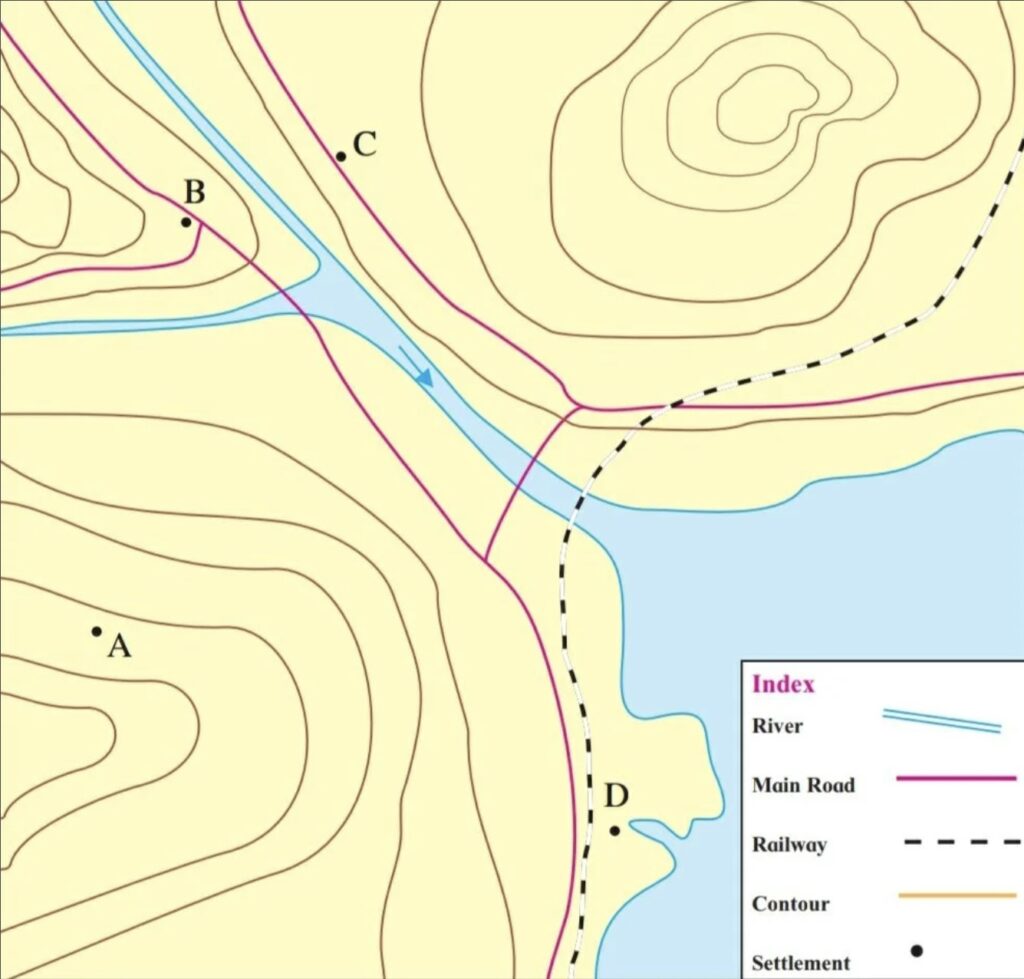
Q.3. Study the diagram and identify the types of settlements.
- Settlement ‘A’ has 5–6 houses and does not have other facilities.
Ans: Scattered settlement. - ‘B’ has a high school, a big market, and a small theatre.
Ans: Nucleated settlements. - ‘C’ has houses, farms, many shops, and small industries.
Ans: Linear settlements. - ‘D’ is a natural harbour, and many industries have been established there.
Ans: Linear settlements.
‘C’ is a settlement that has developed along the roadside. Give two reasons for its location here.
Ans:
‘C’ is an example of a Linear Settlement.
- Transport facilities are easily available along the road, which helps in trade and communication.
- Such settlements can quickly develop into villages due to the availability of shops and road, railway, or river transport facilities.