Maharashtra Board Class 8 Civics Chapter 4 – The Indian Judicial System Solutions
📘 1. Choose the Correct Option and Complete the Statements
(1) Laws are made by __________.
- (a) Legislature
- (b) Council of Ministers
- (c) Judiciary
- (d) Executive
Answer: ✅ Option (a) – Legislature
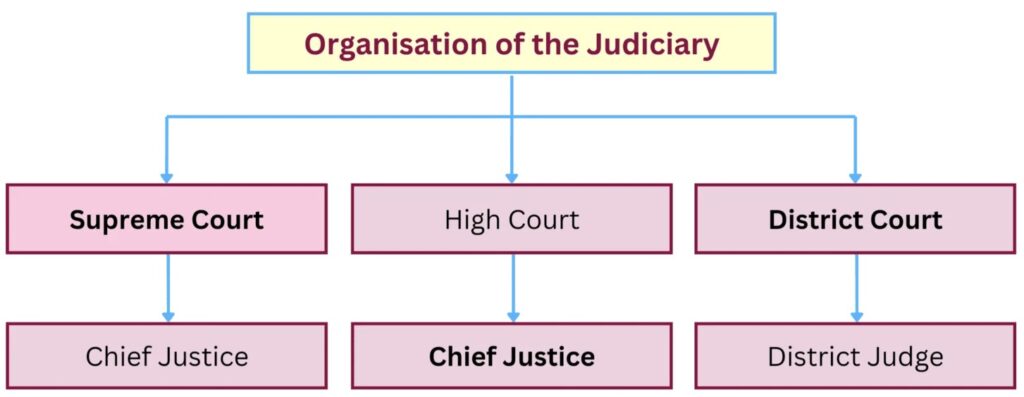
(2) The Chief Justice of the Supreme Court is appointed by __________.
- (a) The Prime Minister
- (b) The President
- (c) The Home Minister
- (d) The Chief Justice
Answer: ✅ Option (b) – The President
📘 2. Explain the Concepts
(1) Judicial Review
- The Constitution is the fundamental law of the nation, and protecting it is the prime responsibility of the Supreme Court.
- Parliament cannot pass any law that violates the Constitution.
- Every act or policy made by the Executive must be consistent with the Constitution.
- If any law passed by the Legislature or any act of the Executive violates the Constitution, it is declared illegal.
- Such a law or act is struck down by the Supreme Court.
- This power of the Supreme Court is known as Judicial Review.
(2) Public Interest Litigation (PIL)
- Public Interest Litigation (PIL) refers to litigation filed on issues of public importance and welfare.
- It can be filed by individuals, social organisations, or NGOs on behalf of the public.
- Issues such as rehabilitation of displaced people, environmental protection, and protection of weaker sections are addressed through PIL.
- PIL is an effective and inexpensive method to ensure quick justice.
📘 3. Write Short Notes
(1) Civil and Criminal Law
(a) Civil Law
- Civil law is one of the two main branches of law.
- It deals with disputes related to the rights of individuals.
- Matters such as property disputes, rent agreements, divorce, and contracts fall under civil law.
- The court gives its decision after a petition is filed.
(b) Criminal Law
- Criminal law deals with serious crimes.
- Crimes such as theft, robbery, dowry harassment, and murder fall under criminal law.
- The first step is filing a First Information Report (FIR) with the police.
- After investigation, the case is presented before the court.
- If found guilty, the accused receives punishment according to the law.
(2) Judicial Activism
- Traditionally, courts settled disputes when approached.
- In recent decades, courts have become more active in ensuring justice.
- Judicial activism aims to fulfill constitutional goals of justice and equality.
- Courts have protected the rights of women, tribal communities, workers, farmers, and children.
- Public Interest Litigation has played an important role in promoting judicial activism.
📘 4. Answer in Brief
(1) Why are laws necessary in society?
- Differences in opinions, cultures, and perspectives may lead to conflicts, which are resolved by the judiciary.
- Laws help establish social justice and equality.
- They protect weaker sections such as women, children, differently-abled individuals, and transgender people.
- Laws ensure freedom, equality, and democracy.
- They protect the fundamental rights of citizens.
- Laws prevent the rise of authoritarian and oppressive forces.
Therefore, laws are necessary in society.
(2) Enumerate the functions of the Supreme Court.
- It acts as a federal court to settle disputes between the Centre and the States.
- It protects the fundamental rights of citizens.
- It reviews decisions of lower courts and even its own judgments.
- It provides legal advice to the President on matters of public importance.
(3) Provisions that Preserve the Independence of the Judiciary
- Judges are appointed by the President to avoid political pressure.
- Judges have security of tenure and cannot be removed easily.
- Their salaries are paid from the Consolidated Fund of India.
- Personal criticism of judges for their decisions is considered contempt of court.
- Parliament cannot discuss the decisions of judges.
📘 5. Complete the Table
Answer