
Maharashtra State Board Textbook Solutions
Standard VI – English
Chapter 4.1 – Sleep, My Treasure
Paraphrase of the Poem
Ans: In the poem, the word “treasure” refers to the baby. The mother is speaking to her child and lovingly asking the baby to go to sleep. She describes the calm and peaceful night and tells the child that a beautiful morning will come after the night.
The mother gently puts her baby to sleep and calls the baby her “treasure.” She says that the birds are tired after a long day of activity. They slowly and quietly return to their nests to rest. Since all the birds have gone to their nests, the garden has become very still and peaceful.
Even though the garden is quiet, it still looks bright because of the beautiful lily flowers that shine in the moonlight. At the same time, the daisies, which were blooming earlier in the day, are now fast asleep.
While asking the baby to sleep, the mother also talks about the morning. She says that at dawn the starling (a black bird) wakes up and the sparrow also begins to move and stir. However, at night the meadow is covered in shadows.
The baby should sleep peacefully until morning, just like the flowers and birds resting in the quiet night.
Meanings
| Word | Meaning |
|---|---|
| pleasure | enjoyment or happiness |
| treasure | (here) the baby or child |
| creep | move slowly and quietly |
| still | not moving; calm and quiet |
| alight | brightly lit up |
| stirs | wakes up or moves slightly |
| wrapped | covered |
Pointers
1. Answer the following questions:
(a) Who is the speaker in the poem?
Ans: The speaker in the poem is the mother.
(b) To whom is the poem addressed?
Ans: The poem is addressed to the baby or child.
(c) What time is being described in the poem?
Ans: Night time is being described in the poem.
(d) Name the white and bright things mentioned in the poem.
Ans: The lilies and daisies are the white and bright things mentioned in the poem.
2. Guess the meaning of the following from the context.
(a) The garden still is alight with lilies.
Ans: The garden has become quiet and motionless because the birds have gone to their nests. However, the garden still looks bright and beautiful because of the shining lilies.
(b) Dawn wakes the starling.
Ans: When morning arrives and the sun begins to rise, the starling (a black bird) wakes up and becomes active again.
(c) The meadow is wrapped in shadow.
Ans: The meadow looks dark because the sun has set and the area is covered in the shadows of the night.
3. What is your favourite time of the day? Describe it in detail.
Ans: My favourite time of the day is the morning. The cool morning air and the soft sunlight make me feel fresh and energetic. I enjoy hearing the birds chirping and watching the sun rise in the sky. Morning also gives me hope and excitement for the day’s activities such as studying, playing, and spending time with my friends and family.
4. Visit a library: Find and read stories and poems written by Edith Nesbit.
Ans: Students must do this activity on their own.
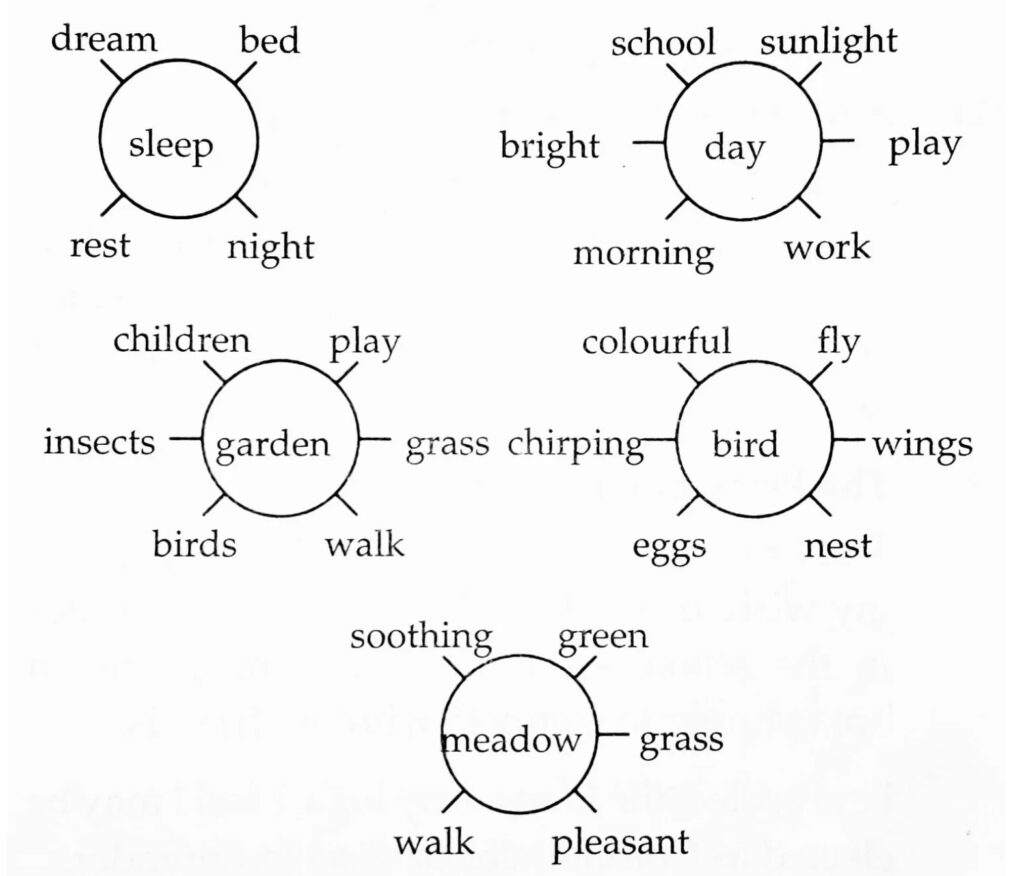
5. Draw word webs for the following.
Begin with the given word and write as many related words as you can to form a word web.
Ans:
6. An activity: Speak fast, think faster!
Form groups of 4–6 students. Discuss the topics given below. Each student should choose one topic and speak about it for one minute, trying to say as many sentences as possible.
(a) What may happen …
(i) I may study …
Ans: I may study harder this weekend because I have some important lessons to revise. If I study sincerely, I may understand the topics better and perform well in my examinations.
(ii) A bird may fly into the classroom …
Ans: A bird may accidentally fly into the classroom through the window. It might get frightened and start flying around the room. We should open the windows and doors so that it can safely fly out.
(iii) The Principal may call me …
Ans: The Principal may call me if I participate in the school elections or competitions. I may get a chance to represent my class or school in an important activity.
(iv) It may rain …
Ans: It may rain because the sky looks cloudy. Heavy rain may help farmers grow crops and fill rivers and lakes with water.
(v) Dog may chase a cat.
Ans: A dog may chase a cat because it is natural for them to run after each other. The cat may quickly climb a wall or tree to escape.
(vi) A king…..kingdom
Ans: A king may lose his kingdom if he does not rule wisely and treat his people fairly. A good king must be just, kind, and responsible.
(vii) My friend … read
Ans: My friend may give me an interesting storybook to read. If the story is exciting, I may finish reading it very quickly.
(viii) Mother may make idlis today.
Ans: Mother may make idlis today because our relatives are visiting us. She prepares delicious idlis with tasty chutney and sambhar.
(b) What is not likely to happen or will never happen …
(i) It won’t rain in the classroom …
Ans: It will not rain in the classroom because the building has a strong roof. Even if it rains heavily outside, we will stay dry inside the classroom.
(ii) I won’t ever see a live dinosaur …
Ans: I will never see a live dinosaur because dinosaurs became extinct millions of years ago. Today we can only learn about them through fossils and books.
(iii) The sun will never set in the east …
Ans: The sun will never set in the east because it always rises in the east and sets in the west due to the rotation of the Earth.
(c) Imagine you are watching a scene and give a running commentary.
Example: Someone learning to ride a bicycle.
Ans: Monu is sitting on the bicycle with the help of side wheels. He tries to push the pedal down but suddenly stops. His uncle holds the seat with one hand and the handle with the other.
“Come on, Monu!” his uncle says.
Monu tries again. The bicycle tilts slightly to one side and he almost falls, but his uncle quickly supports him. Monu gathers courage and pedals again. Slowly he moves forward and manages to ride the bicycle for a short distance.
Everyone claps as Monu smiles happily.