
Maharashtra State Board
Standard VI – History
Chapter 10 – Ancient India: Cultural
1. Answer in one sentence.
(1) Make a list of ancient Indian universities.
Ans: Takshashila, Varanasi, Nalanda, Valabhi, Kanchi, and Vikramshila were some of the ancient Indian universities.
(2) Make a list of the Indian goods that were in demand in foreign countries.
Ans: Indian goods such as fine textiles, ivory articles, precious stones, spices, and earthen pottery were in great demand in foreign countries.
2. Name the following.
Epics and poetic compositions of ancient India.
Ans: The Ramayana, Mahabharata, Raghuvansha, Kumarasambhava, Kiratarjuniya, and Shishupalavadha are some well-known epics and poetic compositions of ancient India.
3. Fill in the blanks.
(1) The epic Ramayana was composed by rishi ………..
Ans: Valmiki
(2) The science of Indian medicine is called ……….
Ans: Ayurveda
(3) Thousands of students could live at the …………. university.
Ans: Nalanda
4. Answer in brief.
(1) Explain what is meant by ‘Tipitaka’.
Ans:
(i) The word ‘Pitaka’ means a basket or collection. Here, it refers to a section of Buddhist literature.
(ii) The Tipitaka has three parts:
(a) Vinaya Pitaka – It contains rules for regulating the Buddhist Sangha.
(b) Sutta Pitaka – It contains the teachings of Lord Buddha.
(c) Abhidhamma Pitaka – It contains the detailed philosophical analysis of Buddhist doctrines.
(2) What is the message of the Bhagavad Gita?
Ans:
(i) The Bhagavad Gita teaches that every person should perform his or her duties sincerely without expecting rewards.
(ii) It also teaches that devotion (bhakti) and faith lead to salvation.
(iii) Its message is meant for all people.
(3) What aspects does Ayurveda take into account?
Ans:
(i) Ayurveda is the ancient Indian science of medicine.
(ii) It explains the symptoms of various diseases.
(iii) It gives information about diagnosis and medicines.
(iv) It also focuses on maintaining good health through proper diet and lifestyle.
(4) What is meant by Sangam Literature?
Ans:
(i) ‘Sangam’ means a gathering of learned people. The literature created in such gatherings is known as Sangam Literature.
(ii) It is the oldest literature in the Tamil language.
(iii) ‘Silappadikaram’ and ‘Manimekhalai’ are two famous works of Sangam Literature.
(iv) From Sangam Literature, we learn about the political, social, and cultural life of South India during that period.
5. Discuss.
Art and architecture of the Maurya and Gupta period.
Ans:
(i) Indian art and architecture developed greatly during the Maurya and Gupta periods.
(ii) The stone pillars erected by Emperor Ashoka are fine examples of sculpture.
(iii) The Great Stupa at Sanchi is an important example of Buddhist architecture.
(iv) The caves at Udayagiri, Khandagiri, Karla, Nashik, Ajanta, and Ellora show the advancement of Indian art.
(v) These monuments reflect the high level of skill and creativity achieved during these periods.
6. What would you do?
(1) How would you obtain information about Ayurvedic medicine and use it in your day-to-day life?
Ans:
Ayurveda is an ancient Indian system of medicine. To learn about it, I would ask my parents and grandparents for guidance. I would also read books and use reliable sources to gather information.
I would follow healthy habits such as eating nutritious food, waking up early, and maintaining cleanliness. I would also try to use simple home remedies and natural herbs when necessary. In this way, I would apply Ayurvedic principles in my daily life.
(2) On a trip to a historical site, your friend is writing his name on the structure.
Ans:
If my friend writes his name on a historical monument, I would politely stop him. I would explain that such monuments are part of our national heritage and must be protected. Damaging them by writing or scratching spoils their beauty.
I would tell him that it is our duty to preserve historical sites for future generations. I would also encourage him to spread awareness among others.
7. Observe the picture of the stupa at Sanchi and obtain more information about it.
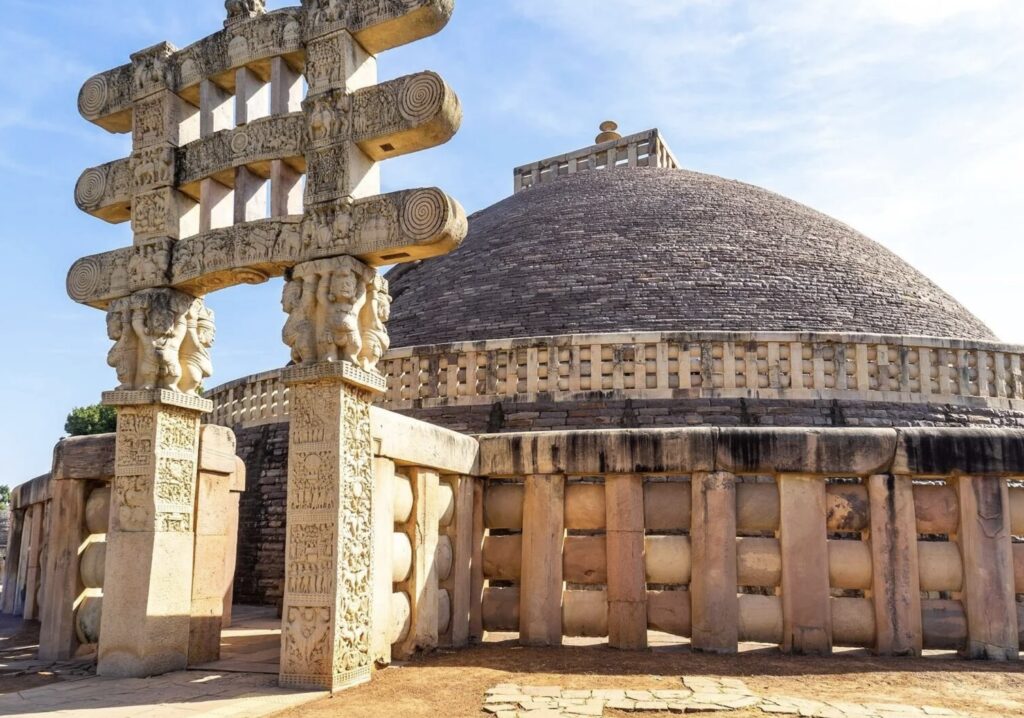
Ans: The Great Stupa at Sanchi is one of the oldest stone structures in India and an important example of Buddhist architecture. It was originally built during the reign of Emperor Ashoka.
The stupa has four beautifully carved gateways known as toranas. These gateways are decorated with sculptures that show scenes from the life of Buddha.
The Great Stupa is located at Sanchi in the Raisen district of Madhya Pradesh, about 46 kilometres from Bhopal. It is an important historical and tourist site and attracts visitors from all over the world.