
Maharashtra State Board
Standard VI – Geography
Chapter 5 – Temperature
(A) Where am I?
(1) The isotherm 0°C runs in my surroundings.
Ans: I must be in the polar region because temperatures around 0°C are found in very cold areas near the poles.
(2) The mean annual temperature is 25°C around me.
Ans: I must be in the tropical region because tropical areas have high temperatures throughout the year.
(3) The mean annual temperature around me is 10°C.
Ans: I must be in the temperate region because temperate regions have moderate temperatures.
(B) Who am I?
(1) I connect places of equal temperature.
Ans: I am an isotherm.
(2) I am useful for measuring the correct temperature.
Ans: I am a thermometer.
(3) I get heated due to the land or water near me.
Ans: I am the air, because air gets heated by the land or water around it.
(4) Land and water get heated due to me.
Ans: I am the Sun, because it is the main source of heat and light for the Earth.
(C) Answer the following.
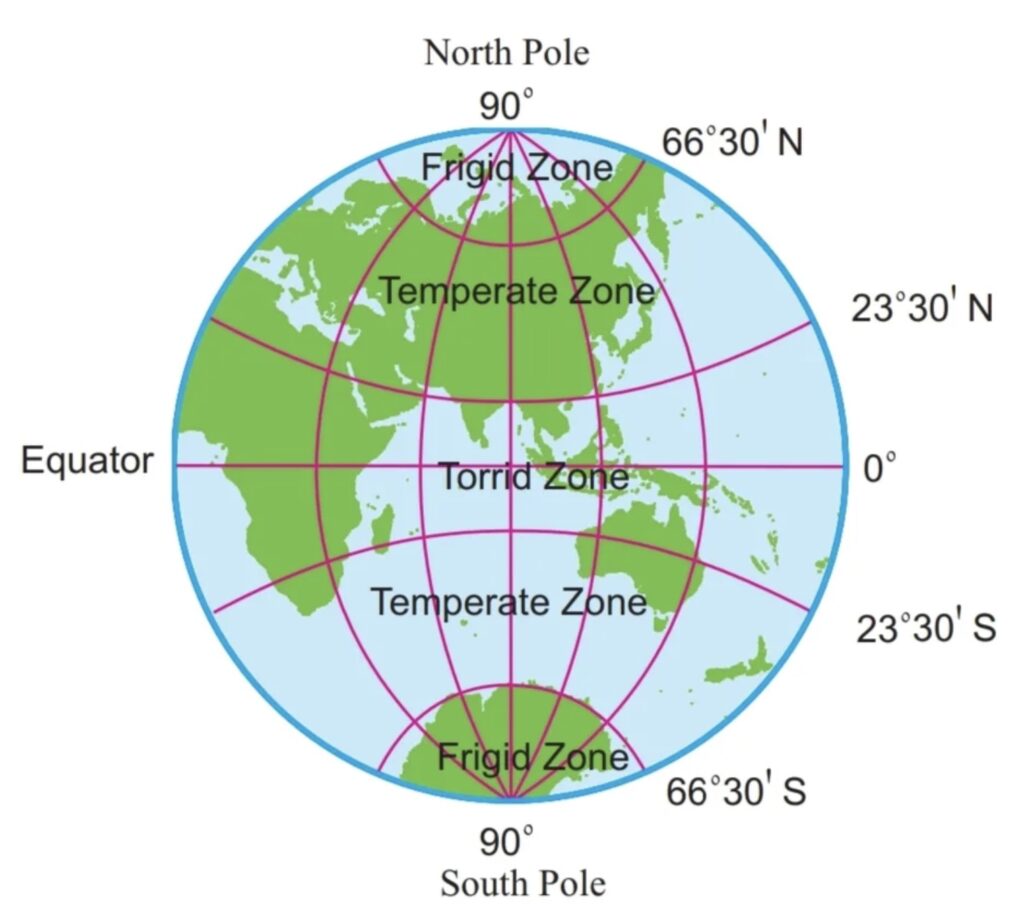
(1) Explain with a diagram, the effect of the spherical shape of the earth on the temperature at different latitudes.
Ans:
(i) The Earth is spherical in shape. Because of this shape, the Sun’s rays fall differently on different parts of the Earth.
(ii) Near the Equator, the Sun’s rays fall almost vertically. Therefore, this region receives more heat.
(iii) Towards the North and South Poles, the Sun’s rays fall slanting. Hence, these regions receive less heat.
(iv) Due to this unequal distribution of heat, there is a difference in temperature from the Equator to the Poles.
(v) Based on temperature, the Earth is divided into three heat zones:
(a) Torrid Zone:
It lies between 0° and 23°30′ North and South of the Equator. The Sun’s rays fall vertically here. Therefore, this zone receives maximum heat.
(b) Temperate Zone:
It lies between 23°30′ and 66°30′ North and South. The Sun’s rays fall slanting here. Therefore, this zone receives moderate heat.
(c) Frigid Zone:
It lies between 66°30′ and 90° North and South. The Sun’s rays fall very slanting here. Therefore, this zone receives very little heat.
(2) What is the relation between the latitudinal extent and temperature of a region?
Ans:
(i) Due to the spherical shape of the Earth, the Sun’s rays fall vertically near the Equator and slanting towards the Poles.
(ii) Regions between 0° and 23°30′ North and South receive direct sunlight and have high temperatures.
(iii) Regions between 23°30′ and 66°30′ North and South receive slanting rays and have moderate temperatures.
(iv) Regions between 66°30′ and 90° North and South receive very slanting rays and have very low temperatures.
(v) Thus, temperature decreases as we move from the Equator towards the Poles.
(3) What makes the isotherms run zigzag over continental areas?
Ans:
(i) The temperature of land areas changes according to their height above sea level. As we go higher, the temperature decreases.
(ii) Differences in landforms such as mountains and plains affect temperature.
(iii) Vegetation cover, cities, and industries also influence temperature.
(iv) Because of these variations in temperature, isotherms do not run straight. They run in a zigzag pattern over continental areas.