Maharashtra Board Textbook Solutions for Standard IX
Chapter 4 – The United Nations (UN)
1. Choose the Correct Option and Complete the Statements
(1) This country is not a permanent member of the United Nations Security Council –
(a) America
(b) Russia
(c) Germany
(d) China
Answer: (c) Germany
(2) This international organisation conducts workshops in India on remedial measures to tackle the problem of malnutrition among children –
(a) UNICEF
(b) UNESCO
(c) Trusteeship Council
(d) Red Cross
Answer: (a) UNICEF
(3) The number of members of the United Nations –
(a) 190
(b) 193
(c) 198
(d) 199
Answer: (b) 193
2. State Whether True or False (Give Reasons)
(1) The United Nations General Assembly is a platform to discuss global problems.
Answer: True
Reason:
(i) The General Assembly meets annually to discuss important global issues such as environment and disarmament.
(ii) It provides a platform for representatives of member nations to discuss and make policy decisions on matters of global importance.
(2) The status of all the member nations of the United Nations is not equal.
Answer: False
Reason:
(i) According to the principles of the UN, all member nations have equal status.
(ii) There is no discrimination based on geography, economy, or military power.
(3) A resolution can be passed even if China exercises its veto power.
Answer: False
Reason:
(i) China is one of the five permanent members of the Security Council and has veto power.
(ii) If any one of the permanent members exercises veto power, the resolution cannot be passed.
(4) India has played a major role in the work of the United Nations.
Answer: True
Reason:
(i) India has contributed troops to United Nations peacekeeping forces.
(ii) India has raised important issues like decolonization, disarmament, and racial discrimination at the UN.
3. Explain the Following Concepts
(1) Veto
(i) The Security Council consists of 15 members – five permanent and ten non-permanent members.
(ii) For a resolution to be passed, it must receive the approval of all five permanent members.
(iii) The permanent members are America, Russia, England, France, and China.
(iv) If any one of these permanent members casts a negative vote (veto), the resolution cannot be adopted.
(2) UNICEF
(i) UNICEF is an affiliated organisation of the United Nations.
(ii) It works for the welfare of children by providing nutritious food and healthcare.
(iii) It organizes workshops and programmes to tackle problems such as child malnutrition.
4. Answer in Brief
(1) Write the reasons for the establishment of the United Nations.
(i) Two World Wars in the twentieth century caused massive destruction of life and property.
(ii) The League of Nations was formed after World War I but failed to maintain peace.
(iii) After the use of nuclear weapons in World War II, there was a need to prevent further destructive wars.
(iv) Therefore, the United Nations was established to maintain international peace and security.
(2) What is the role of the Peacekeeping Forces of the United Nations?
(i) UN peacekeeping forces create conditions favorable for establishing permanent peace in conflict areas.
(ii) They provide security in strife-torn regions.
(iii) They assist in restoring normalcy and maintaining peace.
(iv) Peacekeeping is an important task undertaken by the UN to safeguard global peace.
(3) Write the objectives of the United Nations.
The main objectives of the United Nations are:
(i) To establish friendly relations among nations.
(ii) To maintain international peace and security.
(iii) To safeguard human rights and fundamental freedoms.
(iv) To promote international cooperation in economic and social fields.
5. Activity-Based Questions
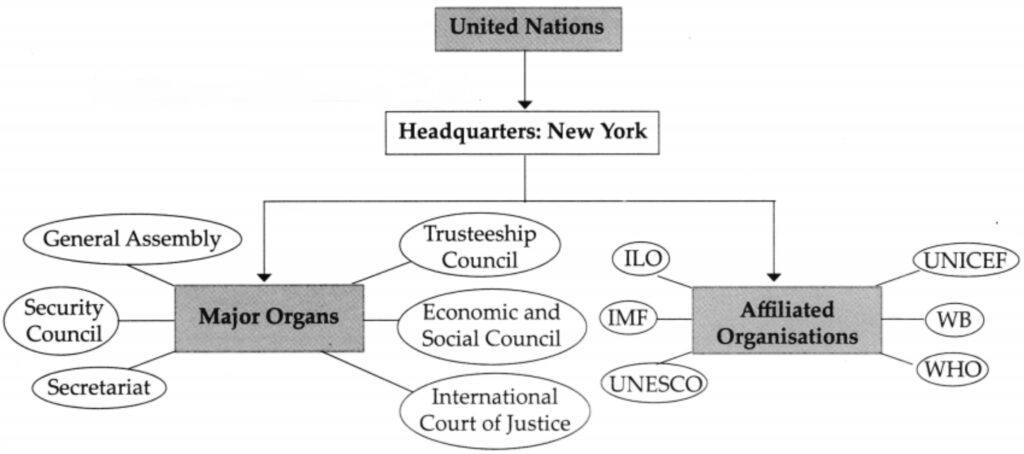
(1) Information About the Organs of the United Nations
| Organ | Number of Members | Functions |
|---|---|---|
| United Nations General Assembly | 193 | Discusses global issues and makes policy decisions. |
| United Nations Security Council | 15 | Maintains international peace and security. |
| International Court of Justice | 15 | Settles disputes between member nations. |
| Economic and Social Council | 54 | Coordinates economic and social policies. |
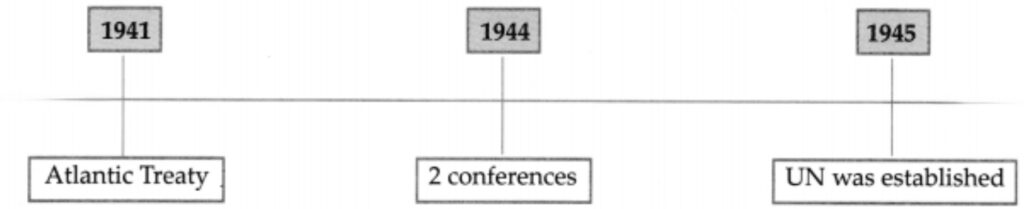
(2) Chronology of the Establishment of the United Nations
(3) Tree Diagram – Organs of the United Nations