🌍 Maharashtra State Board – Standard IX
📘 Chapter 8 – Introduction to Economics
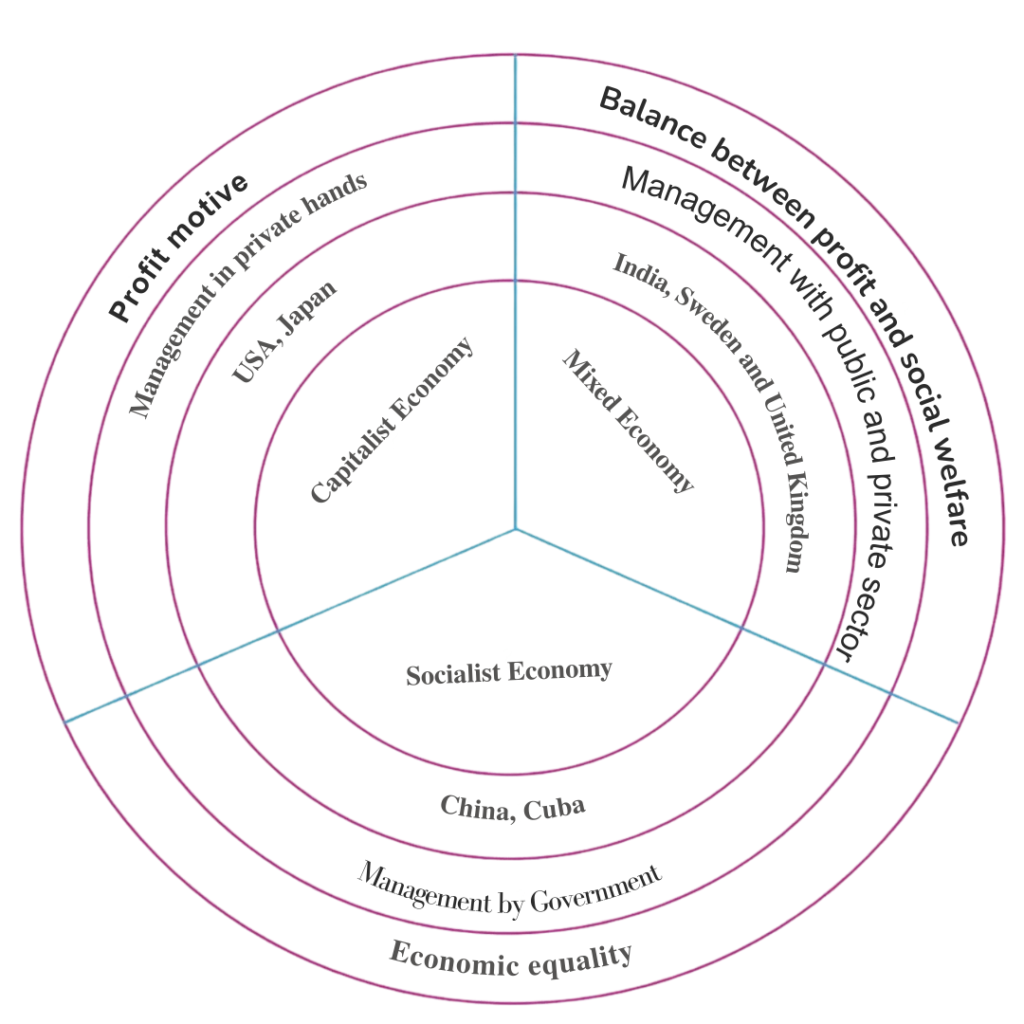
Q.1) Explain the types of economies by filling the correct information in the circle.
Ans.
Q.2) Give explanation:
(1) Economy begins at home.
- The word ‘economics’ comes from the Greek word ‘oikonomia’, which means family management.
- Managing a household requires proper planning of income and expenditure.
- Similarly, villages, cities, states, and countries also need proper economic planning.
- Therefore, the concept of economy begins with managing a home.
(2) India’s economy is of mixed type.
- In India, both private and public sectors operate together.
- Private industries aim at earning profit.
- Public sector industries work for social welfare.
- The government tries to maintain a balance between profit-making and social welfare.
- Hence, India’s economy is called a mixed economy.
(3) On the basis of economies, we can divide countries into three groups.
- An economy includes activities related to the production, distribution, and consumption of goods and services in a particular region.
- On the global level, countries can be divided into three types of economies.
- Capitalist Economy – Ownership and management are in private hands.
- Socialist Economy – Ownership and control are in the hands of the government.
- Mixed Economy – Both public and private sectors coexist.
Q.3) Write the following answers in one line:
(1) To which economic factor is the management of individual or family finances related?
Ans: Management of individual or family finances is related to income and expenditure.
(2) From which Greek word is the term ‘Economics’ derived?
Ans: The term ‘Economics’ is derived from the Greek word ‘oikonomia’, which means family management.
(3) In a capitalist economy, to whom does the ownership and management of means of production belong?
Ans: In a capitalist economy, the ownership and management of means of production belong to private individuals.
(4) What do you mean by globalisation?
Ans: Globalisation means integrating or linking a country’s economy with the world economy through free trade and fewer restrictions on investment.