
🌆 Maharashtra State Board – Std. IX
📘 Chapter 10 – Urbanisation
✅ Q.1 Suggest measures for the following problems:
(A) The slums in the cities are increasing.
Ans:
- Local self-government should provide basic facilities such as water, sanitation, and electricity in slum areas.
- The government should generate more employment opportunities to reduce poverty.
- Affordable and quality education should be provided so that people can improve their standard of living.
- Proper housing schemes should be implemented for economically weaker sections.
(B) Because of increasing traffic jams within the city, a lot of time is consumed in commuting.
Ans:
- A better and efficient public transport system should be developed to reduce the use of private vehicles.
- Roads should be widened and repaired regularly, especially after the monsoon season.
- Carpooling and the use of bicycles should be encouraged.
(C) The question of law and order in urban areas is serious.
Ans:
- Corruption and bribery must be strictly controlled.
- A strong judicial system and strict implementation of laws are necessary.
- Police patrolling should be increased to maintain safety and security.
(D) The problem of pollution is grave because of urbanisation.
Ans:
- The government should implement strict environmental laws and regulations.
- Public transport should be promoted to reduce vehicular pollution.
- Tree plantation drives should be encouraged in urban areas.
(E) Migration has created questions of health and education in urban areas.
Ans:
- Basic health and sanitation facilities should be provided to migrant populations.
- Affordable education facilities should be made available to all sections of society.
- More schools and healthcare centres should be established in urban areas.
✅ Q.2 Match the correct pairs:
| Group A | Group B |
|---|---|
| (1) Technological development and mechanisation | (D) Urbanisation |
| (2) Permanently staying away from your original place | (C) Migration |
| (3) 75% males are engaged in non-agricultural occupation | (A) Urban areas |
| (4) The problems of solid waste | (B) Lack of planning |
✅ Q.3 Outline the importance / advantages of the following:
(A) Technology and Mechanisation
- Technology and mechanisation increase industrial production.
- They create employment opportunities in industries.
- Mechanisation in agriculture releases surplus labour, which leads to migration towards cities.
- This contributes to urbanisation.
(B) Trade
- Places with good transport and storage facilities develop as trade centres.
- Trade leads to the development of markets, banks, and business complexes.
- For example, Nagpur developed as a trade centre due to its central location.
(C) Industrialisation
- Industrialisation increases employment opportunities.
- It attracts people from surrounding rural areas.
- The growth of Mumbai in the 19th century was due to textile mills.
- Many villages became part of metropolitan cities due to industrialisation.
(D) Amenities in Urban Areas
- Urban areas provide better transport and communication facilities.
- Educational and medical facilities are well developed.
- Entertainment and emergency services are available.
- For example, Pune attracts students due to its educational institutions.
(E) Social Harmony in Cities
- People from different regions live together in cities.
- There is an exchange of customs, traditions, and ideas.
- Urbanisation increases employment in secondary and tertiary sectors.
- It promotes cultural understanding and social unity.
✅ Q.4 Compare the following and give examples:
(A) Transportation System and Traffic Jams
- A good transportation system helps people travel easily for work and education.
- When public transport is insufficient, traffic jams increase.
- For example, Mumbai often faces traffic congestion, especially during the monsoon season.
(B) Industrialisation and Air Pollution
- Industrialisation refers to the growth of industries in a region.
- More industries increase air pollution if environmental laws are not followed.
- For example, cities like Delhi and Faridabad face severe air pollution due to rapid industrialisation.
(C) Migration and Slums
- Migrants often do not get proper jobs immediately.
- Due to low income, they live in slums with poor facilities.
- For example, Dharavi in Mumbai developed due to large-scale migration.
(D) Amenities and Increasing Crime Rate
- Some migrants may remain unemployed.
- Lack of employment may lead to illegal activities.
- Crimes such as theft and pickpocketing disturb social harmony.
✅ Q.5 Complete the table:
| Process of Urbanisation | Effects |
|---|---|
| Emergence of slums | Illegal settlements and insufficient facilities |
| Migration | Increase in population (short-term or long-term) |
| Pollution | Long-term health problems and unhygienic conditions |
| Industrialisation | Employment generation and increase in amenities |
| Change from rural to urban | Formation of Municipal Corporations, modernisation, and development of occupations |
✅ Q.6 Explain:
(A) The growth of cities takes place in a specific method.
- Cities develop in a planned manner through government schemes.
- The Smart City Mission uses information and communication technology (ICT) for better planning.
- It improves transport, communication, and emergency services.
(B) A planned city of your imagination
- A smart city with the use of modern technology.
- Green buildings with low pollution levels.
- More parks and green spaces.
- Proper rehabilitation of slums.
- Strong public transport system.
- Strict law and order.
(C) Industrialisation causes cities to develop.
- Industrialisation increases employment opportunities.
- It attracts people from rural areas.
- This increases the urban population.
- Many villages become part of cities due to industrial growth.
(D) Pollution – A Problem
- Pollution is a major issue in cities.
- It affects human health and the environment.
- Air, water, and noise pollution are common.
- As cities grow, pollution levels increase.
(E) Swachh Bharat Abhiyan
- Swachh Bharat Abhiyan is a cleanliness campaign by the Government of India.
- It means “Clean India Initiative.”
- It was launched on 2nd October 2014 at Rajghat, New Delhi by Prime Minister Narendra Modi.
- It aims to clean streets, roads, and public places across India.
✅ Q.7 Suggest measures for the problems of urbanisation shown in the pictures.
(1) Air Pollution (Industries)
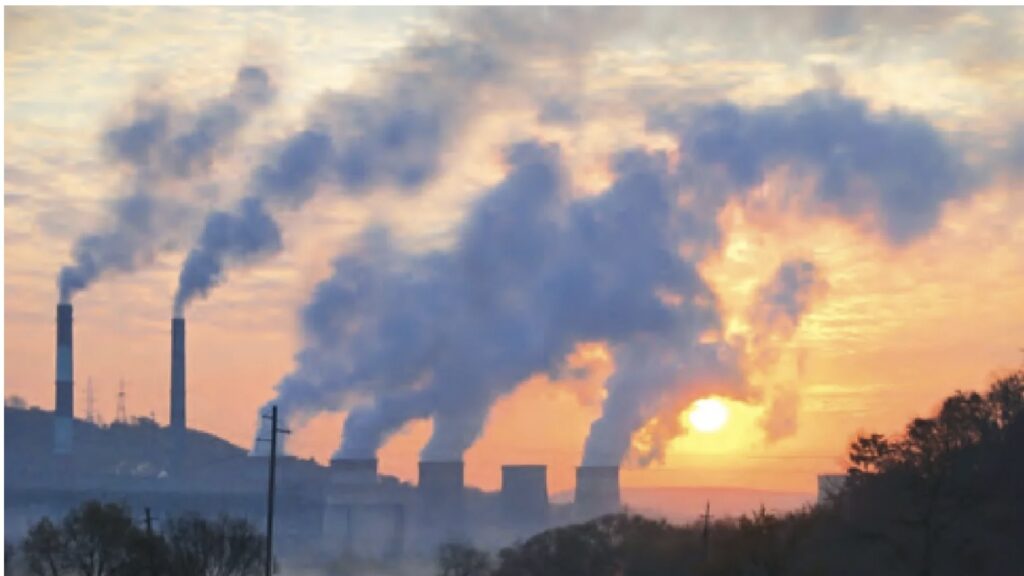
- Industries should use cleaner fuels such as natural gas.
- Industrial areas should be located away from residential areas.
- Proper filters should be installed in factories.
(2) Noise Pollution
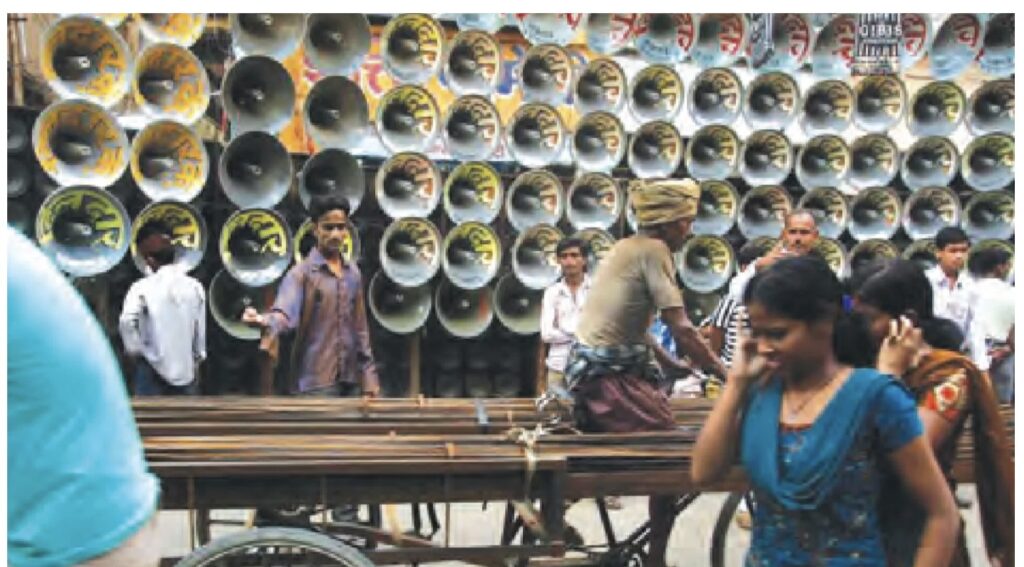
- Noise levels should be controlled within permissible limits.
- Loudspeakers and horns should be used carefully.
- Doors and windows should be closed while using noisy machines.
(3) Solid Waste Problem
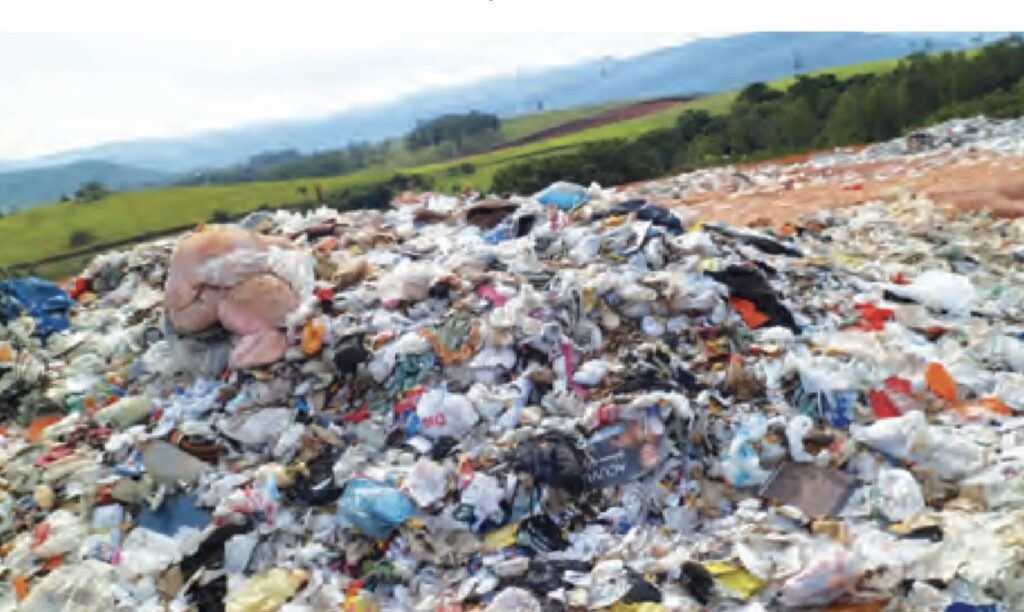
- Do not throw garbage in open areas.
- Follow the 4 R’s – Reduce, Reuse, Recycle, and Repair.
- Separate dry and wet waste for proper disposal.
(4) Water Pollution
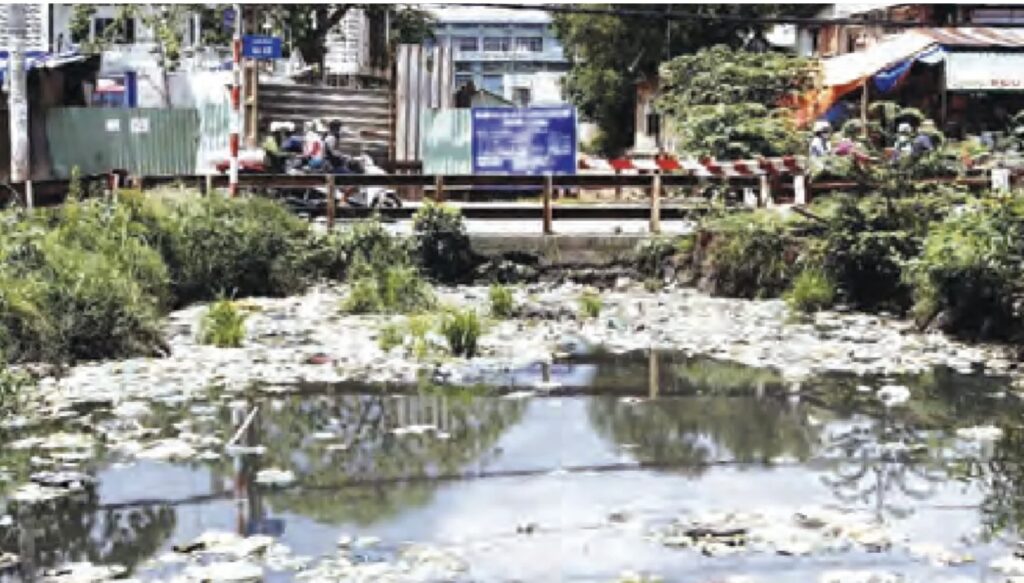
- Sewage water should be treated before releasing it into water bodies.
- Industrial waste should not be directly discharged into rivers.
- Avoid washing clothes and utensils in public water sources.
🌟 Final Note for Students
Urbanisation brings development and opportunities, but it also creates challenges. Proper planning, awareness, and responsible behaviour can help make cities clean, safe, and sustainable.