
Maharashtra State Board
Standard VIII – Science
Chapter 15: Sound
1. Fill in the blanks with appropriate words:
a. The region in a sound wave with higher pressure and density is called __________, and that with lower pressure and density is called __________.
Ans: Compression, Rarefaction
b. A medium is __________ for the generation and propagation of sound.
Ans: Necessary
c. The total number of compressions and rarefactions produced per second in a sound wave is 1000. The frequency of the sound wave is __________.
Ans: 500 Hz
d. Different sound notes have different __________.
Ans: Frequencies
e. In a loudspeaker, __________ energy is converted into __________ energy.
Ans: Electrical energy, Sound energy
2. Give scientific reasons:
a. It is essential to change the tension on the vocal cords as we produce different sound notes from our larynx.
Ans:
(i) Different sound notes have different frequencies.
(ii) In humans, sound is produced when air from the lungs passes through the slit between the vocal cords.
(iii) The frequency of the sound depends on the tension of the vocal cords.
(iv) When the tension changes, the frequency changes.
Therefore, it is essential to change the tension of the vocal cords to produce different sound notes.
b. Astronauts on the Moon cannot hear each other directly.
Ans:
(i) Sound requires a material medium for propagation.
(ii) The Moon has no atmosphere.
(iii) Since there is no medium, sound cannot travel.
Therefore, astronauts on the Moon cannot hear each other directly.
c. As a sound wave propagates in air, the air itself is not required to move from one place to another.
Ans:
(i) Sound waves travel in the form of compressions and rarefactions.
(ii) Air particles vibrate about their mean positions.
(iii) They transfer energy to neighbouring particles.
(iv) The particles do not travel from one place to another.
Therefore, air itself does not move along with the sound wave.
3. How are different sound notes generated in musical instruments like a guitar and a flute?
Ans:
(i) In instruments like a guitar, sound is produced by vibrating strings.
(ii) The frequency of vibration is changed by adjusting the tension or length of the string.
(iii) This produces different musical notes.
(iv) In instruments like a flute, sound is produced by the vibration of the air column.
(v) Opening and closing the holes changes the length of the vibrating air column.
(vi) This changes the frequency and produces different notes.
4. How is sound produced in a human larynx and a loudspeaker?
(A) Sound Production in Humans:
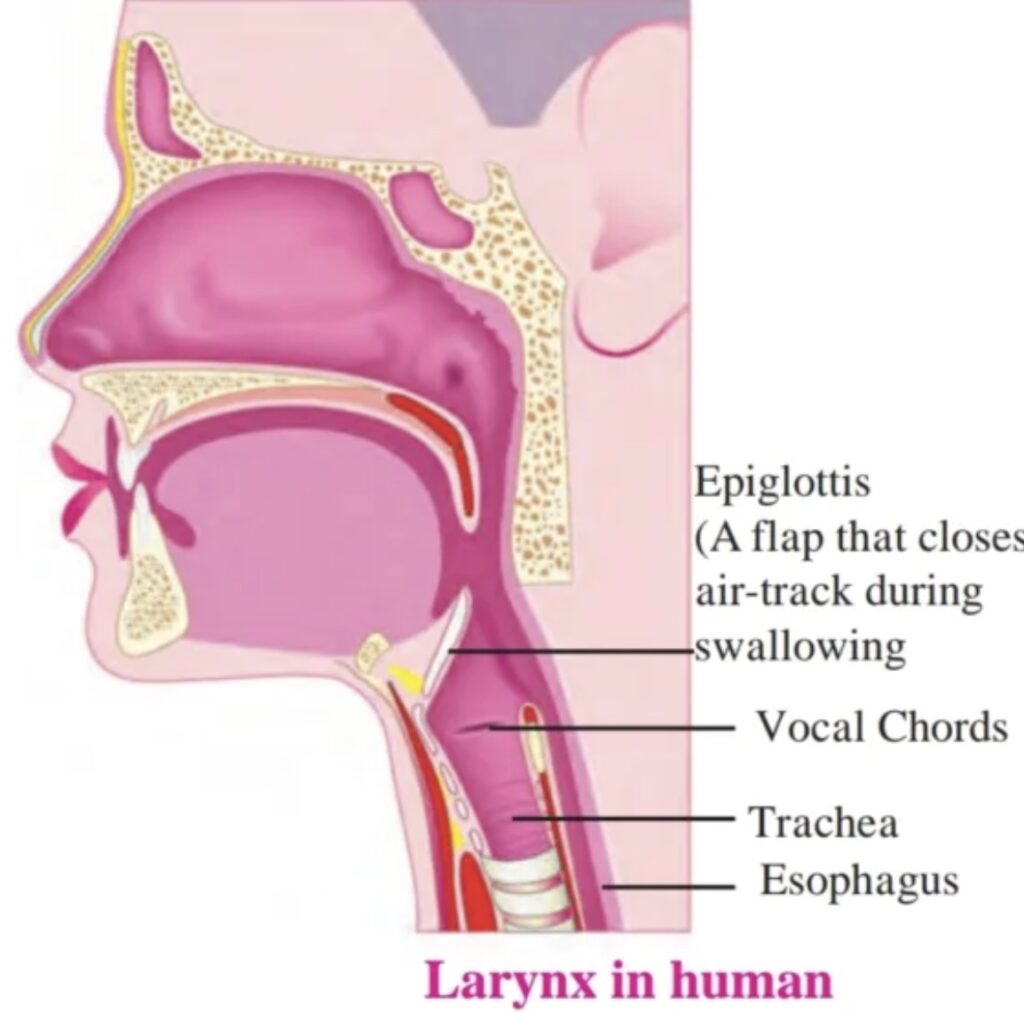
(i) The larynx (voice box) is located at the upper end of the windpipe.
(ii) Two vocal cords are stretched across the larynx.
(iii) When air from the lungs passes through the slit, the vocal cords vibrate.
(iv) These vibrations produce sound.
(v) Tight vocal cords produce high-pitched sounds, and loose cords produce low-pitched sounds.
(B) Sound Production in a Loudspeaker:
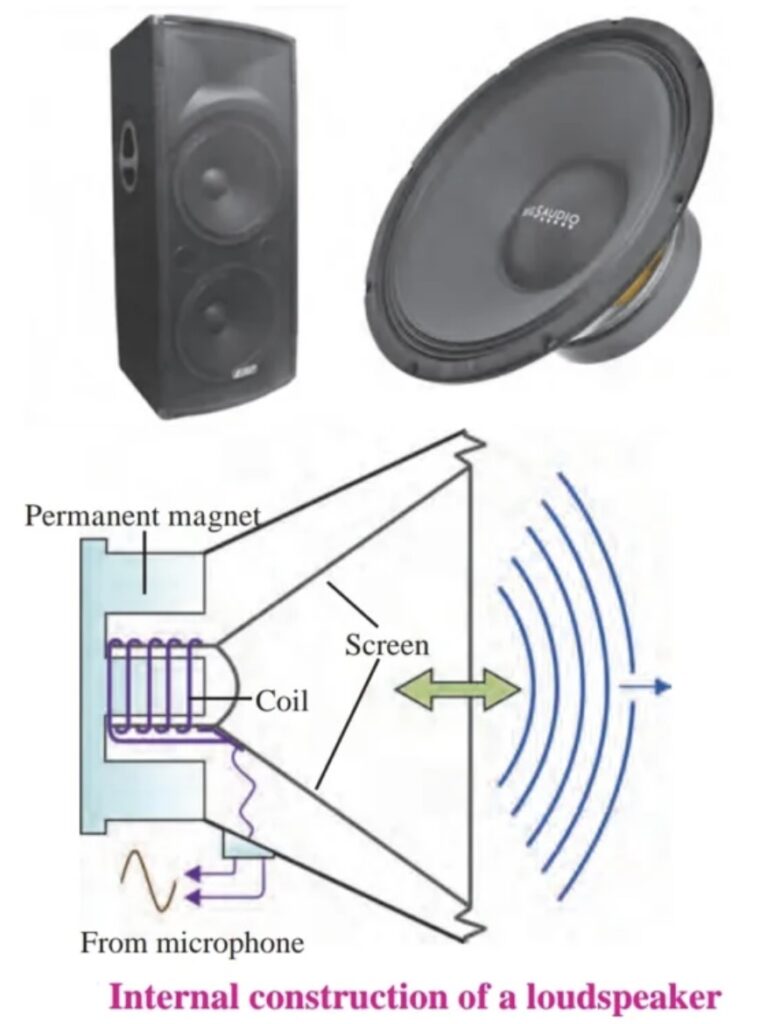
(i) A loudspeaker has a permanent magnet and a coil.
(ii) When electric current flows through the coil, a magnetic field is produced.
(iii) The coil moves back and forth.
(iv) A cone attached to the coil also vibrates.
(v) These vibrations produce sound waves in the air.
5. Explain the experiment to prove: “Sound needs a material medium for propagation.”
Aim: To prove that sound requires a material medium for propagation.
Procedure:
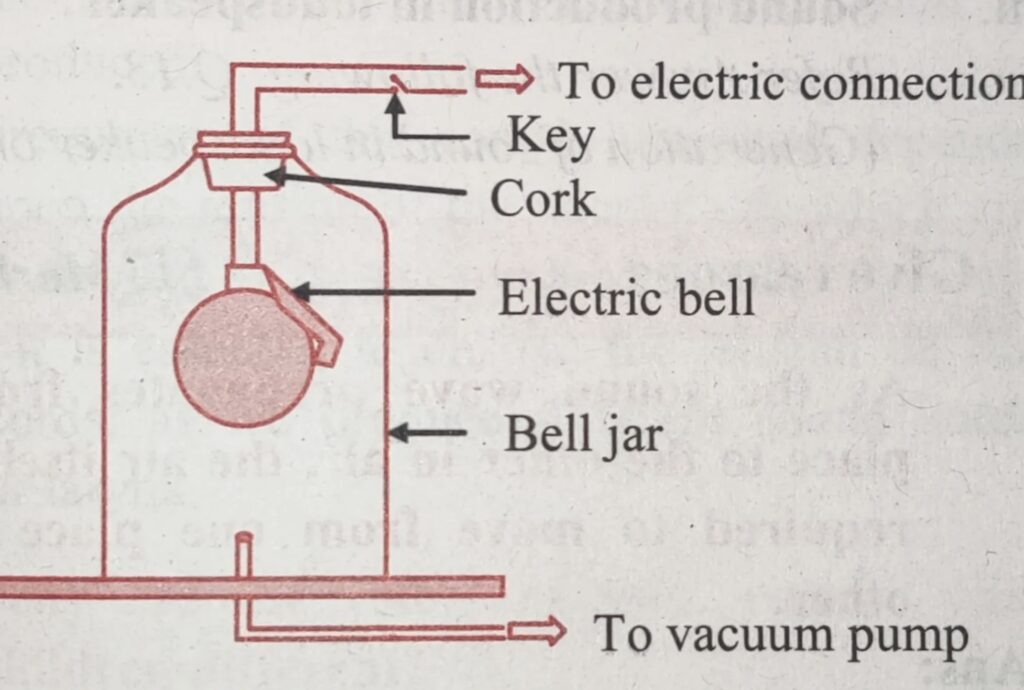
(i) Place an electric bell inside a glass bell jar.
(ii) Connect the bell jar to a vacuum pump.
(iii) Switch on the bell while air is present inside the jar. The sound is heard clearly.
(iv) Start removing air from the jar using the vacuum pump.
Observation:
As air is removed, the sound becomes faint and finally inaudible, although the bell continues to vibrate.
Conclusion:
(i) Sound requires a material medium for propagation.
(ii) Sound cannot travel in a vacuum.
6. Match the Following:
| A | B |
|---|---|
| Human larynx | Vibrations in vocal cords |
| Loudspeaker | Vibrations of screen |
| Jal-tarang | Vibrations in air column |
| Tuning fork | Vibrations of metal arms |
| Sitar | Vibrations in strings |