🌌 Chapter 20 – In the World of Stars
📘 Maharashtra Board Textbook Solutions – Standard Seven
📝 1️⃣ Write the Proper Words in the Blanks
(meridian, horizon, twelve, nine, apparent, celestial, ecliptic)
(a) When seen from a great distance, the sky seems to touch the ground along a circle. This circle is called the ____________.
Ans: horizon.
(b) The ____________ is used while defining the zodiac signs.
Ans: ecliptic.
(c) Classified according to seasons, one season will have ____________ nakshatras.
Ans: nine.
(d) The rising of the Sun in the east and its setting in the west is the ____________ motion of the Sun.
Ans: apparent.
⭐ 2️⃣ A star rises at 8 p.m. tonight. At what time will it rise after a month? Why?
Ans: A star rises approximately 4 minutes earlier every day.
In 30 days:
4 × 30 = 120 minutes
120 minutes = 2 hours
Therefore, after one month, the star will rise 2 hours earlier, that is, at 6 p.m.
This happens because of the Earth’s revolution around the Sun, which causes stars to appear to rise slightly earlier each day.
🌠 3️⃣ What is meant by “The Sun enters a nakshatra”? It is said that in the rainy season the Sun enters the Mrug nakshatra. What does it mean?
Ans: When we observe the Sun, we also see the constellation located behind it. A nakshatra is identified by its brightest star.
When we say that “the Sun enters a nakshatra,” it means that the particular nakshatra lies behind the Sun at that time.
Thus, when it is said that during the rainy season the Sun enters the Mrug nakshatra (Orion), it means that during that period the constellation Orion is positioned behind the Sun.
❓ 4️⃣ Answer the Following Questions
(a) What is a constellation?
Ans: A constellation is a group of stars occupying a small portion of the celestial sphere and forming a recognizable pattern.
(b) What points should be considered before a sky watch?
Ans: The following points should be considered before a sky watch:
- The place for sky watching should be away from city lights; preferably, it should be a new moon night.
- Binoculars or telescopes should be used for better observation.
- Identifying the Pole Star in the north makes observing easier; it should be used as a reference point.
- As stars in the west set earlier, sky watching should begin with the western sky.
- In a sky map, east and west are shown on the right and left, respectively.
- On a sky map, north and south appear at the bottom and top, respectively, because the map is held overhead.
(c) Is it wrong to say that planets, stars and nakshatras affect human life? Why?
Ans: Yes, it is wrong to say that planets, stars, and nakshatras affect human life. There is no scientific evidence supporting such claims. Science is based on observations, experiments, and evidence, not on beliefs. Therefore, such ideas are not accepted in scientific study.
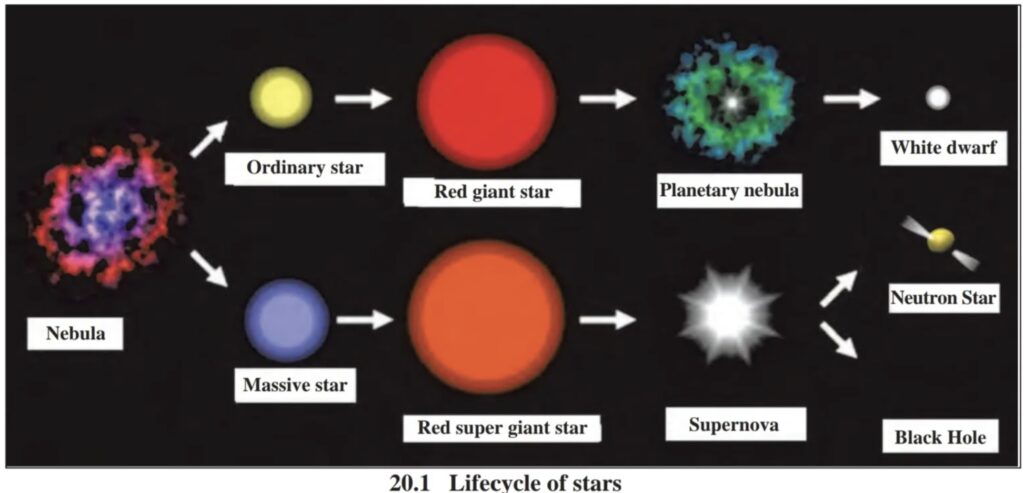
🌟 5️⃣ Write a paragraph on the birth and lifecycle of stars.
Ans: Stars are born from nebulae, which are large clouds made mainly of hydrogen gas and dust particles. Due to gravity, particles in a nebula attract each other. As a result, the cloud contracts and becomes dense and spherical in shape.
At the same time, the pressure and temperature at the core increase tremendously, and nuclear reactions begin. This marks the birth of a star.
Over millions or billions of years, stars undergo gradual changes such as contraction, expansion, and temperature variations. These changes form the lifecycle of a star. The different stages in this lifecycle give rise to different types of stars.