Maharashtra State Board
Standard VII – Science
Chapter 12 – The Muscular System and Digestive System in Human Beings
Textbook Solutions
1. Fill in the blanks with the right word from the brackets.
(a) The process of digestion starts from the ………….. (stomach / mouth)
Ans: mouth
(b) Eyelids have ………………. muscles (voluntary / involuntary)
Ans: Voluntary
(c) ……………. is not a function of the muscular system. (Production of blood cells / Performing movements)
Ans: Production of blood cells
(d) Muscles of the heart are ……………. (ordinary muscles / cardiac muscles)
Ans: Cardiac muscles
(e) Pushing forward the food that has been chewed is the function of the …………. (stomach / oesophagus).
Ans: Oesophagus
2. Find a match for me.
| Group ‘A’ | Group ‘B’ |
|---|---|
| (1) Cardiac muscles | (a) always functions in pairs |
| (2) Are brought about by muscles | (b) we never feel tired |
| (3) Pepsin | (c) uncontrolled and painful contraction of muscles |
| (4) Cramps | (d) chewing movements of jaws |
| (5) Skeletal muscles | (e) enzyme of the gastric juice |
Ans:
| Group ‘A’ | Group ‘B’ |
|---|---|
| (1) Cardiac muscles | (b) we never feel tired |
| (2) Are brought about by muscles | (d) chewing movements of jaws |
| (3) Pepsin | (e) enzyme of the gastric juice |
| (4) Cramps | (c) uncontrolled and painful contraction of muscles |
| (5) Skeletal muscles | (a) always function in pairs |
3. Who is telling a lie?
1. Tongue – My taste-buds can tell only a sweet taste.
Ans:
The tongue is telling a lie. The taste buds on the tongue can detect different tastes such as sweet, sour, salty, bitter, and umami.
2. Liver – I am the largest gland in the body.
Ans:
The liver is telling the truth. It is the largest gland in the human body.
3. Large intestine – I am 7.5 meters long.
Ans:
The large intestine is telling a lie. The large intestine is about 1.5 meters long.
4. Appendix – Digestion is impossible without me.
Ans:
The appendix is telling a lie. The appendix does not play an important role in digestion, and a person can live normally without it.
5. Lung – I play an important role in excretion.
Ans:
The lung is telling a lie. The kidneys play the most important role in excretion by removing waste from the blood.
4. Give reasons.
(1) Food becomes acidic in the stomach.
Ans: Hydrochloric acid (HCl) is present in the stomach. When food reaches the stomach, this acid mixes with it and helps break it down into smaller particles. Because of the presence of this acid, the food becomes acidic in the stomach.
(2) Cardiac muscles are said to be involuntary muscles.
Ans: Cardiac muscles are called involuntary muscles because they work automatically and are not controlled by our will. These muscles are found only in the heart and continue to work throughout life without getting tired.
(3) Intoxicating substances should not be consumed.
Ans: Intoxicating substances such as tobacco, cigarettes, and alcohol are harmful to the body. They can damage different organs and may cause serious diseases such as cancer. These substances also disturb the normal functioning of body systems. Therefore, intoxicating substances should not be consumed.
(4) Your muscles should be strong and efficient.
Ans: Muscles help us perform many movements such as walking, running, talking, and lifting objects. They also help the body carry out many important functions. Therefore, muscles should be strong and efficient to help us perform daily activities properly.
5. Answer the following.
(a) How many types of muscles are there? Which are those types?
Ans: There are three types of muscles in the human body:
- Skeletal or voluntary muscles
- Smooth or involuntary muscles
- Cardiac muscles
(b) What causes the problem of acidity? What is its effect on the body?
Ans: Hydrochloric acid is normally present in the stomach to help in digestion. When the amount of this acid increases beyond normal levels, it causes acidity. This can lead to problems such as acid reflux, burning sensation in the chest, headache, vomiting, and irritation in the stomach. Long-term acidity may also lead to stomach ulcers.
(c) Name the different types of teeth. What is the function of each type?
Ans: There are four types of teeth in humans:
- Incisors – used for cutting and biting food.
- Canines – used for tearing food.
- Premolars – used for crushing and grinding food.
- Molars – used for grinding and chewing food thoroughly.
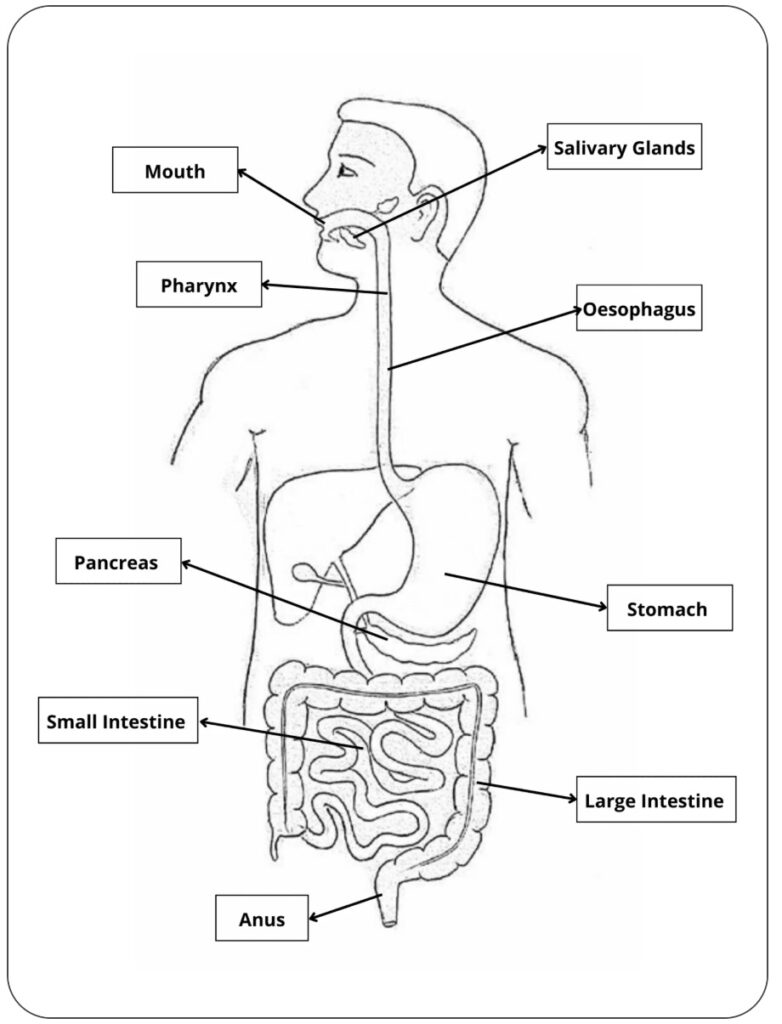
6. Sketch and label a diagram of the digestive system and describe it in your own words.
Ans: Digestion is the process by which food is broken down into simpler substances that the body can absorb and use for energy and growth.
The human digestive system consists of the alimentary canal and digestive glands.
The main digestive organs are:
- Mouth
- Salivary glands
- Pharynx
- Oesophagus
- Stomach
- Pancreas
- Small intestine
- Large intestine
- Anus
Process of Digestion:
- Food enters the mouth, where saliva and the enzyme salivary amylase begin the digestion of starch.
- The food passes through the oesophagus into the stomach, where gastric juice helps digest proteins.
- The partially digested food then enters the small intestine, where pancreatic juice, bile juice, and intestinal juice complete the digestion of carbohydrates, proteins, and fats.
- The small intestine absorbs nutrients into the blood.
- The remaining undigested food passes into the large intestine, where water is absorbed.
- Finally, waste material is removed from the body through the anus.