
Maharashtra State Board Textbook Solutions
Standard VII – Science
Chapter 11 – Cell Structure and Micro-organisms
1. Answer the following questions:
(a) What is a ‘cell’?
Ans: A cell is the basic structural and functional unit of all living organisms.
(b) Name the different organelles in a cell?
Ans: The different cell organelles are the nucleus, endoplasmic reticulum, ribosomes, Golgi body, lysosomes, mitochondria, plastids, and vacuoles.
(c) What are micro-organisms?
Ans: Micro-organisms are living organisms that cannot be seen with the naked eye and can be observed only with the help of a microscope.
(d) Which are the different types of micro-organisms?
Ans: The different types of micro-organisms are bacteria, viruses, fungi, algae, and protozoa.
2. Fill in the blanks with the proper word:
(a) The organelle called the ………… is present in plant cells only.
Ans: Chloroplast
(b) Garbage is converted into …………. by micro-organisms.
Ans: Manure
(c) In the cell, photosynthesis is carried out with the help of ……………
Ans: Chloroplasts
(d) An electron microscope is necessary for the study of ……………
Ans: Cell organelles
3. What is the difference between:
(a) Plant cell and animal cell
| Plant Cell | Animal Cell |
|---|---|
| Plant cells have a cell wall. | Animal cells do not have a cell wall. |
| Plant cells contain a large central vacuole. | Animal cells contain small vacuoles. |
| Chloroplasts are present. | Chloroplasts are absent. |
(b) Prokaryotic cell and eukaryotic cell
| Prokaryotic Cell | Eukaryotic Cell |
|---|---|
| Contains a nucleoid instead of a true nucleus. | Contains a well-defined nucleus. |
| Membrane-bound organelles are absent. | Membrane-bound organelles are present. |
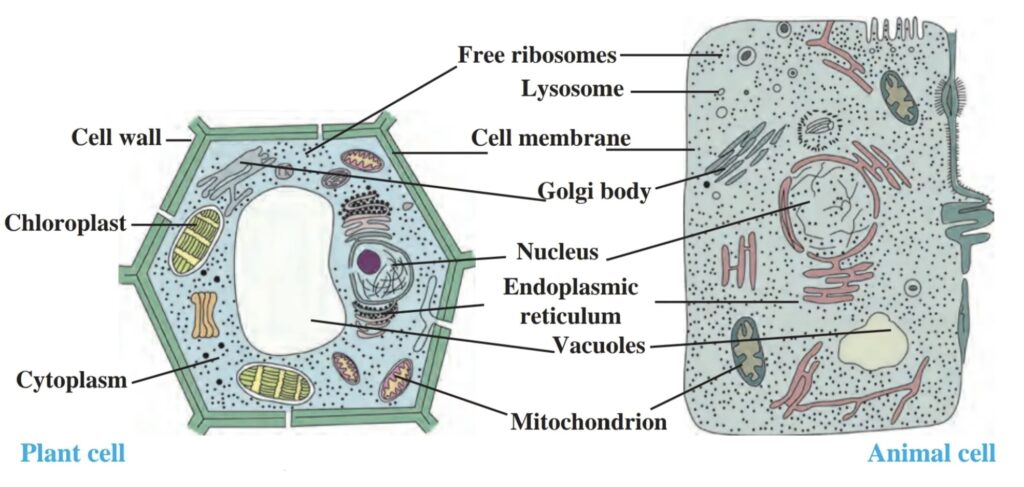
4. Sketch and describe in your own words, the plant cell and animal cell.
Plant Cell
Ans:
(i) Plant cells have a definite shape due to the presence of a cell wall.
(ii) They contain a large central vacuole.
(iii) They have chloroplasts, which help in photosynthesis.
Animal Cell
Ans:
(i) The plasma membrane is the outermost covering of animal cells.
(ii) Animal cells have small vacuoles.
(iii) They do not contain chloroplasts, so they cannot perform photosynthesis.
5. Explain the uses and the harmful effects of micro-organisms.
Uses of micro-organisms
Ans:
(i) Micro-organisms decompose waste materials and convert them into manure.
(ii) Some micro-organisms help in nitrogen fixation in the soil.
(iii) They are used in fermentation and in making food products like curd, cheese, butter, and bread.
(iv) They are used to produce antibiotics and vaccines.
(v) Some micro-organisms help in cleaning oil spills in water bodies.
Harmful effects of micro-organisms
Ans:
(i) Some micro-organisms spoil food by producing toxic substances.
(ii) Eating contaminated food can cause food poisoning.
(iii) They cause diseases such as cholera, typhoid, hepatitis, and gastroenteritis.
(iv) Airborne microbes can cause diseases like cold, cough, tuberculosis, and pneumonia.
(v) Some micro-organisms spread diseases like malaria, dengue, and yellow fever.
6. Give reasons:
(a) Diseases spread on a large scale during periods of heavy rainfall and floods.
Ans:
(i) Heavy rainfall and floods create favourable conditions for the growth of disease-causing micro-organisms.
(ii) Floodwater spreads contaminated water, especially in areas with poor sanitation.
Therefore, diseases spread widely during such conditions.
(b) There is a possibility of food poisoning if we eat stale food.
Ans:
(i) Micro-organisms grow on stale food and release harmful toxins.
(ii) These toxins spoil the food and can cause illness.
Therefore, eating stale food may lead to food poisoning.
(c) Soil is turned over during tilling.
Ans:
(i) Tilling loosens the soil and improves air circulation.
(ii) It helps micro-organisms decompose organic matter and increase soil fertility.
Therefore, soil is turned over during tilling.
(d) Fungus grows quickly in moist or humid conditions.
Ans:
(i) Fungi need moisture to grow and reproduce.
(ii) Humid conditions provide an ideal environment for their growth.
Therefore, fungi grow quickly in moist conditions.
(e) A refrigerator is used in almost every home.
Ans:
(i) A refrigerator maintains a low temperature (about 0°C to 4°C).
(ii) Micro-organisms grow slowly at low temperatures.
Therefore, food stays fresh for a longer time.
(f) Bread ‘rises’ during baking.
Ans:
(i) Yeast is used in bread-making.
(ii) Yeast carries out fermentation and produces carbon dioxide gas.
(iii) The gas makes the dough expand.
Therefore, bread rises during baking.
(g) Fodder is soaked in water before offering to cattle.
Ans:
(i) Soaking helps in sprouting the grains.
(ii) Sprouted fodder is rich in nutrients like proteins.
Therefore, soaked fodder is healthier for cattle.
7. When will you use a simple microscope and when, a compound microscope? Explain in detail how you will use them.
Ans:
(i) A microscope is an instrument used to magnify small objects that cannot be seen clearly with the naked eye.
(ii) A simple microscope is used to observe small objects that are visible but need enlargement, such as insects or plant parts.
(iii) A compound microscope is used to observe very small objects like cells and micro-organisms.
(iv) To use a microscope, the specimen is placed on a glass slide.
(v) For solid specimens, the object is placed directly on the slide.
(vi) For liquid samples like blood, a thin layer is spread on the slide.
(vii) The slide is placed under the microscope, and the focus is adjusted to get a clear and magnified image.