
Chapter 8 – How Seasons Occur (Part 2)
Maharashtra Board Textbook Solutions for Standard Seven
1. Complete the Statements Using the Correct Options
1) The apparent movement of the sun means ……..
(a) The sun revolves around the earth in a year
(b) It appears that the sun moves to the north or south in a year.
(c) The earth keeps on changing its position.
Ans: (b) It appears that the sun moves to the north or south in a year.
2) If the axis of the earth were not tilted ……….
(a) The earth would not have rotated around itself.
(b) The earth would have revolved around the sun with greater velocity.
(c) Different parallels on the earth would have experienced the same climate throughout the year.
Ans: (c) Different parallels on the earth would have experienced the same climate throughout the year.
3) 21st June and 22nd December are solstice days, that is, ……………..
(a) The sun starts its southward journey from the Tropic of Cancer on 21st June and its northward journey from the Tropic of Capricorn on 22nd December.
(b) The Dakshinayan of the sun takes place between 21st June and 22nd December.
(c) The Uttarayan of the earth takes place between 21st June and 22nd December.
Ans: (a) The sun starts its southward journey from the Tropic of Cancer on 21st June and its northward journey from the Tropic of Capricorn on 22nd December.
4) The revolution of the earth around the Sun and the tilt of the earth’s axis together are responsible for the following seasons:
(a) Summer, rainy season, retreat of monsoon and winter
(b) Summer, winter and spring
(c) Summer and winter
Ans: (c) Summer and winter.
2. Answer the Following Questions
1) What leads to the occurrence of seasons?
Ans: Seasons occur due to the revolution of the earth around the Sun and the tilt of the earth’s axis.
2) What is the duration of the day on an equinox?
Ans: On an equinox, the duration of day and night is equal. There are 12 hours of daytime and 12 hours of nighttime.
3) Why is the effect of the seasons not experienced in the equatorial region?
Ans: The equatorial region receives nearly perpendicular sunrays throughout the year. As a result, there is very little change in temperature. Therefore, the equatorial region does not experience distinct seasons.
4) Why is the sun visible for more than 24 hours during Dakshinayan in the region between the Antarctic Circle and the South Pole?
Ans: During the period from 23rd September to 21st March (Dakshinayan), the southern hemisphere tilts towards the Sun. The region between the Antarctic Circle and the South Pole remains within the zone of illumination. Therefore, the sun is visible for more than 24 hours in this region.
5) Why are penguins not found at the North Pole?
Ans: Penguins are native to the Antarctic region in the southern hemisphere. They have adapted to the natural conditions of the South Pole. Hence, they are not found at the North Pole.
3. Rewrite the Following Statements After Correcting Them
- The earth’s velocity varies according to the period of revolution.
Ans: The earth’s velocity varies due to its rotation. - If we observe from the northern hemisphere, we see the apparent movement of the sun.
Ans: The apparent movement of the sun can be observed from both the northern and southern hemispheres. - The dates of equinox change every year.
Ans: The dates of the equinox do not change every year; they may vary by a day. - North Canada experiences summer from September to March.
Ans: North Canada experiences winter from September to March. - When it is summer in South Africa, Australia has winter.
Ans: When it is summer in South Africa, Australia also has summer. - Duration of daytime is less on the vernal and autumnal equinoxes.
Ans: The duration of daytime and nighttime is equal on the vernal and autumnal equinoxes.
4. Spot the Error in the Diagram
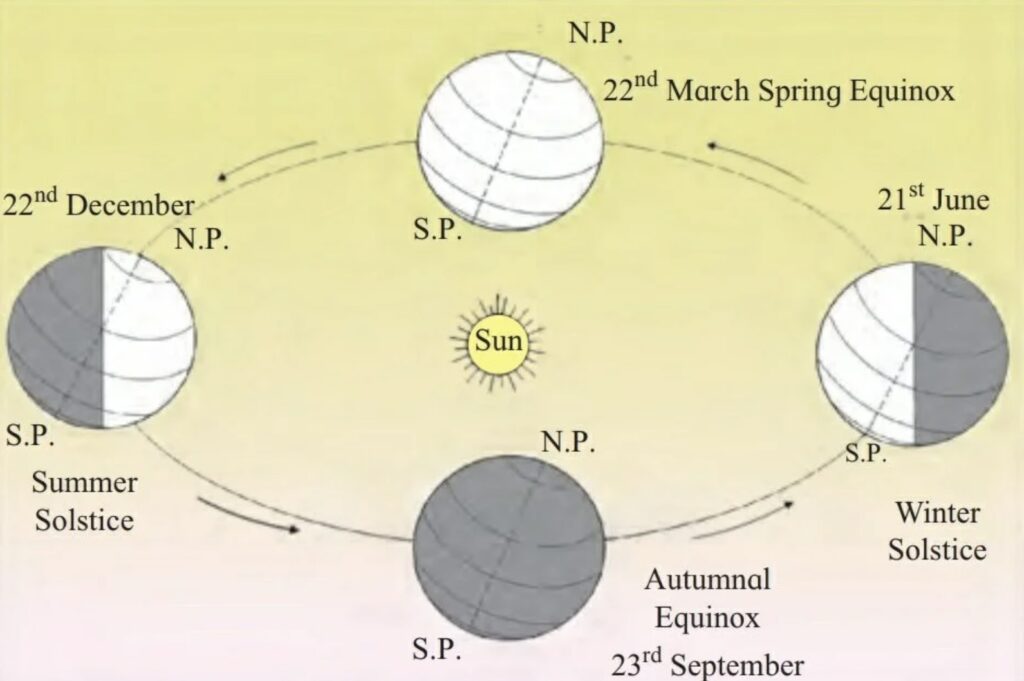
Ans:
- In the northern hemisphere, the summer solstice should be on 21st June.
- In the northern hemisphere, the winter solstice should be on 22nd December.
- In the southern hemisphere, the summer solstice should be marked as the winter solstice.
- In the southern hemisphere, the winter solstice should be marked as the summer solstice.
5. Draw a Diagram Showing the Cycle of Seasons in the Southern Hemisphere
Ans:
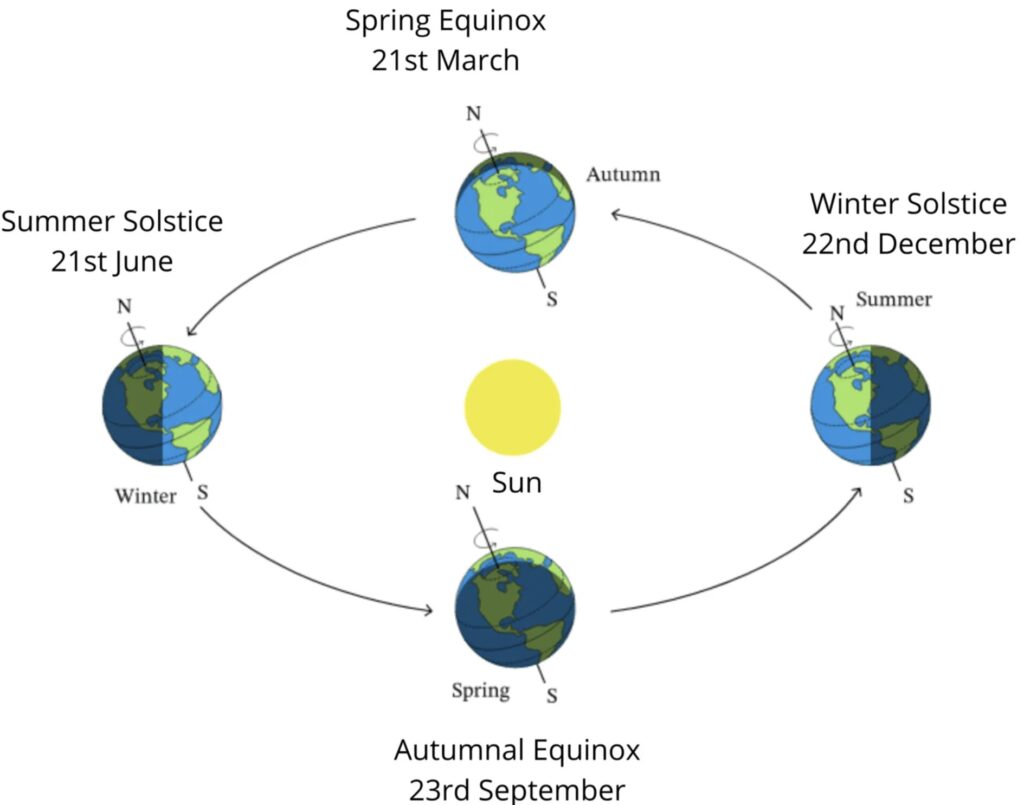
- 21st June – Winter in the Southern Hemisphere
- 23rd September – Spring (Equinox)
- 22nd December – Summer in the Southern Hemisphere
- 21st March – Autumn (Equinox)