
Maharashtra Board Textbook Solutions
Standard 6 – Science
Chapter 15 – Fun with Magnets
🧲 1. How will you do this?
(a) Determine whether a material is magnetic or non-magnetic.
Ans: If a material sticks to a magnet, it is a magnetic material. If it does not stick to a magnet, it is a non-magnetic material.
(b) Explain that a magnet has a certain magnetic field.
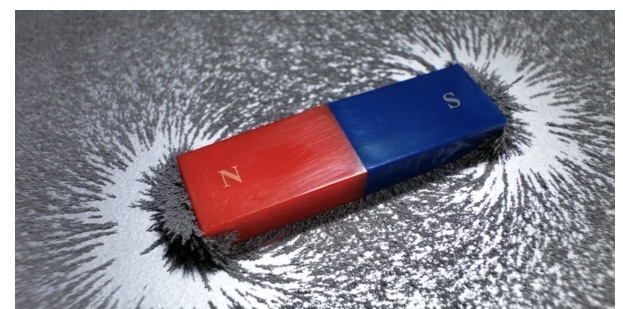
Ans: Every magnet has an invisible area around it called a magnetic field. This can be shown with the help of the following activity:
(i) Take some iron filings, a bar magnet, and a cardboard sheet.
(ii) Sprinkle the iron filings on the cardboard sheet.
(iii) Bring the bar magnet near the filings.
(iv) You will observe that the iron filings arrange themselves in a particular pattern around the magnet.
This pattern shows the magnetic field of the magnet. The lines are closer near the poles and farther apart near the centre.
(c) Find the north pole of a magnet.
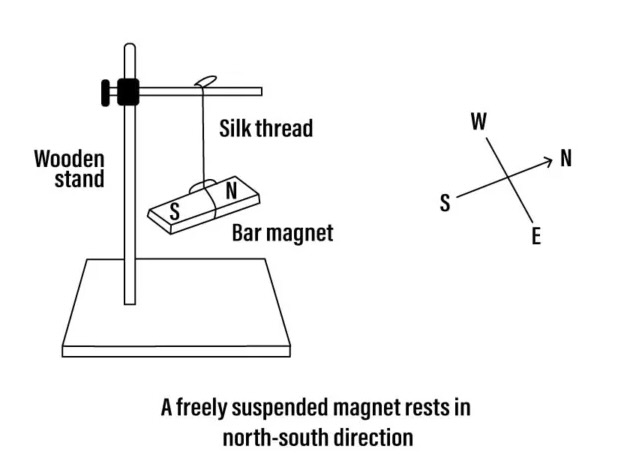
Ans: Tie a thread to the centre of a magnet and hang it freely. Allow it to come to rest. The end that points towards the geographic north is called the north pole of the magnet.
🧭 2. Which magnet will you use?
(a) Iron is to be separated from trash.
Ans: An electromagnet should be used to separate iron from trash because it is strong and can be controlled.
(b) You are lost in a forest.
Ans: A bar magnet or lodestone can be used to find directions, as it always points in the north-south direction when suspended freely.
(c) A window shutter opens and shuts continuously in the wind.
Ans: A permanent magnet can be used to hold the window shutter in place and stop it from moving.
✍️ 3. Fill in the blanks with the appropriate word.
(a) If a bar magnet is hung by a thread tied at its centre, its north pole becomes steady in the direction of the north pole of the Earth.
(b) If a bar magnet is cut into equal pieces by cutting it at right angles to its axis at two places, three bar magnets are formed, and a total of six poles are formed.
(c) There is repulsion between the like poles of a magnet, and attraction between its opposite poles.
(d) When magnetic material is taken close to a magnet, the material acquires induced magnetism.
(e) If a magnet attracts a piece of metal, that piece must be made of magnetic material or iron.
(f) A magnet remains steady in a north-south direction.
📝 4. Write the answers in your own words.
(a) How is an electromagnet made?
Ans: An electromagnet is made by winding a copper wire around an iron object and passing electric current through the wire. The iron becomes magnetised only when the current flows. When the current is switched off, the magnetism disappears.
(b) Write the properties of a magnet.
Ans: The properties of a magnet are as follows:
(i) A magnet has two poles – the North Pole and the South Pole.
(ii) A freely suspended magnet always rests in the north-south direction.
(iii) A magnet attracts magnetic materials such as iron.
(iv) Like poles repel each other, while unlike poles attract each other.
(v) The poles of a magnet cannot be separated; cutting a magnet forms smaller magnets.
(vi) The magnetic force is strongest at the poles.
(c) What are the practical uses of a magnet?
Ans: Magnets are used in many daily applications:
(i) In doorbells, refrigerator doors, and magnetic clips.
(ii) In cranes to lift heavy iron objects using electromagnets.
(iii) In computers, CDs, and other electronic devices that use magnetic materials.
(iv) In medical machines like MRI and in ATM, credit, and debit cards which have magnetic strips.