Maharashtra State Board
Standard VI – History
Chapter 11 – Ancient India and the World
1. Name the following.
(1) Places where articles made in Rome were found.
Ans: Articles made in Rome were found at Kolhapur in Maharashtra and Arikamedu in Tamil Nadu.
(2) A new style of art that emerged during the Kushana period in India.
Ans: The Gandhara School of Art.
(3) The language of the books Mahavamsa and Deepavamsa.
Ans: Pali.
(4) A country to which Buddhism had spread in the ancient period.
Ans: Sri Lanka.
2. Think and expand / elaborate:
(1) Indian culture had an impact on Southeast Asia.
Ans:
(i) Many Indians travelled to Southeast Asian countries such as Myanmar, Thailand, and Indonesia for trade and to spread religion.
(ii) They carried Indian ideas, philosophy, customs, and religious beliefs with them.
(iii) As a result, Indian culture greatly influenced the art, architecture, language, and traditions of Southeast Asia.
(2) The spread of Buddhism in China became easier.
Ans:
(i) The Ming Emperor of China invited Buddhist monks Dharmarakshaka and Kashyapmatanga to China.
(ii) These monks translated many Buddhist texts from Indian languages into Chinese.
(iii) Because of this translation work, people in China could easily understand Buddhist teachings.
(iv) Therefore, the spread of Buddhism in China became easier.
3. What would you do if you are encouraged in your favourite hobby?
Ans:
If I were encouraged to pursue my favourite hobby, I would work very hard to improve my skills. I would practice regularly and try to achieve success in it. I would remain dedicated and make full use of the opportunity given to me. I would also try to make my parents and teachers proud by doing my best.
4. Describe a picture.
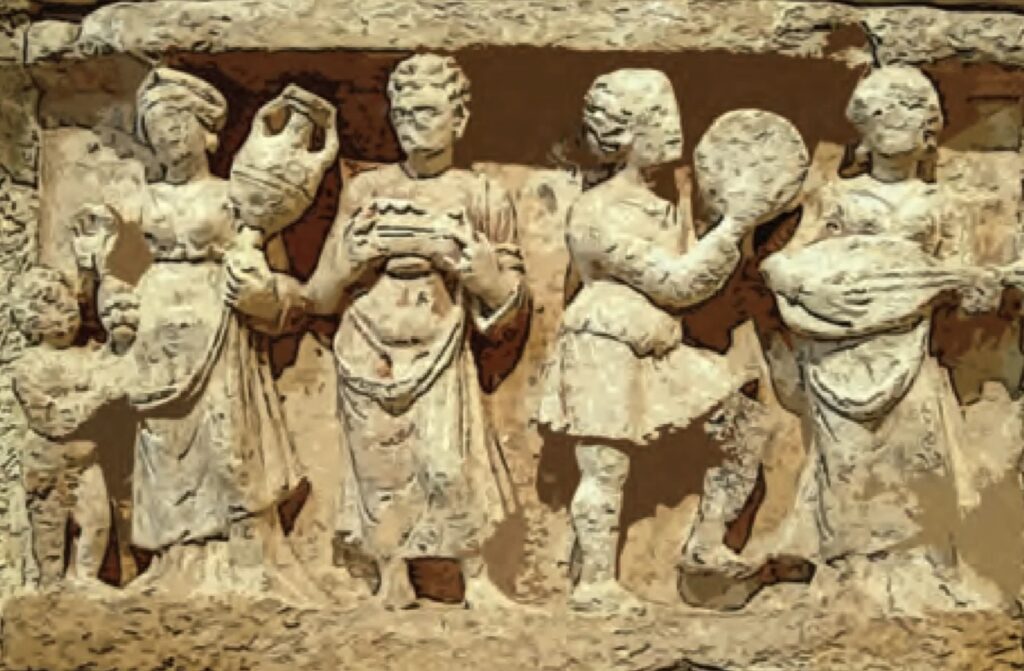
A picture of the Gandhara style sculpture on a stupa in Hadda, Afghanistan is given in this chapter. Observe it and write about it.
Ans:
The Gandhara style sculptures found at the stupa of Hadda in Afghanistan show strong Greek influence. The faces and features of the figures resemble Greek art.
These sculptures mainly depict the life of Gautama Buddha and his followers. The figures appear to be wearing clothes similar to Greek style and some are shown holding musical instruments.
These sculptures are important examples of fine art and architecture of that period. They are also well-preserved because of their religious importance.
5. Find out more about –
(1) The Gandhara style of art
Ans:
(i) During the Kushana period, a new style of art developed under the influence of Greek sculpture. It was known as the Gandhara School of Art.
(ii) In this style, images of Gautama Buddha were mainly carved.
(iii) Since many such sculptures were found in the Gandhara region of Afghanistan, the style came to be known as the Gandhara style of art.
(iv) This style shows a mixture of Indian and Greek artistic features.
(2) The Silk Route
Ans:
(i) The land route used for the trade of silk between Asia and Europe was known as the Silk Route.
(ii) Many important cities in India were connected to this route.
(iii) Nalasopara near Mumbai in Maharashtra was one such place.
(iv) Chinese Buddhist monks Fa-Hien and Yuan Chwang travelled to India through the Silk Route.
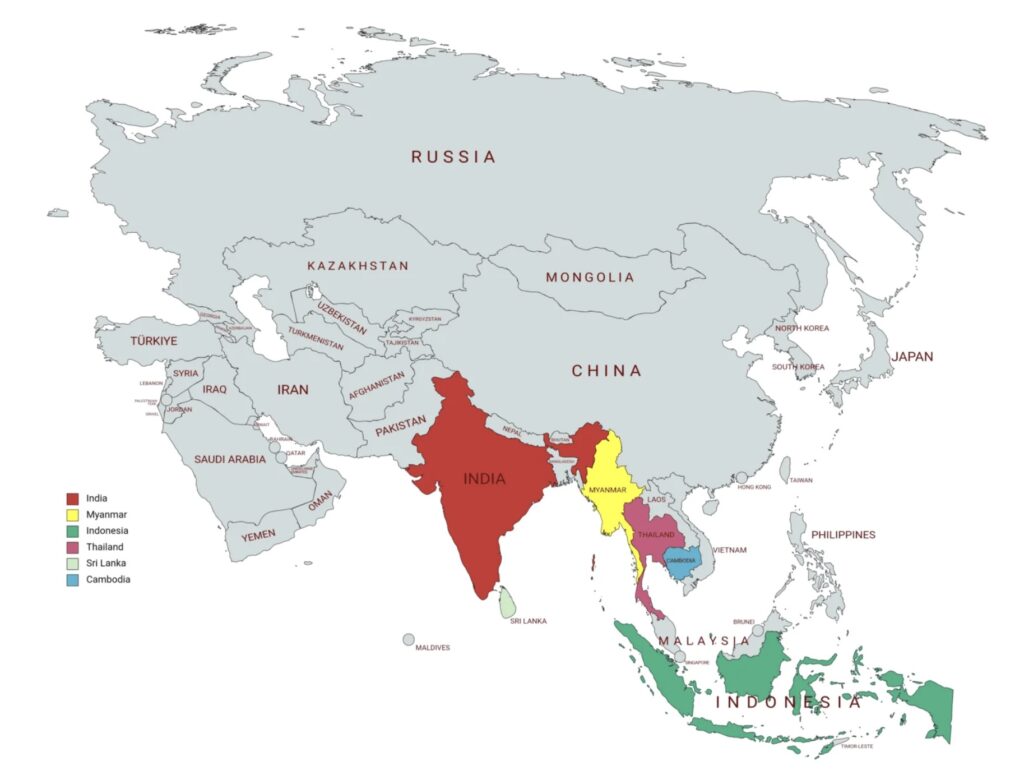
6. Mark the countries of Southeast Asia mentioned in the chapter on an outline map.
Ans: The countries of Southeast Asia mentioned in the chapter are:
- Myanmar
- Thailand
- Indonesia
- Cambodia
- Sri Lanka